
"Khusrau Spies Shirin Bathing", Folio from a Khamsa (Quintet) of Nizami of Ganja
16th century
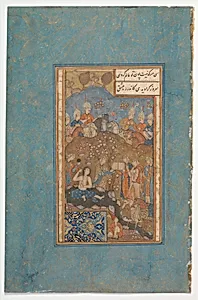
Medium
Ink, opaque watercolor, silver, and gold on paper
Dimensions
Page: H. 8 11/16 in. (22.1 cm) W. 5 11/16 in. (14.4 cm) Dimensions of painting: H. 5 1/4 in. (13.3 cm) W. 2 1/2 in. (6.4cm)
Classification
Codices
Department
Islamic Art
Museum
Metropolitan Museum of Art, New York, NY
Credit
Gift of Richard Ettinghausen, 1975
Accession Number
1975.192.15
Rights
Public Domain
Tags
Art Historical Context
This exquisite folio, titled *"Khusrau Spiesin Bathing"*, from a 16th *Khamsa* (Quintet), a celebrated collection of five epic poems by the 12th-century Persian master Nizami of Ganja. It illustrates a pivotal romantic moment from *Khosrow and Shirin*, of Nizami's love stories, where the Sasanian prince Khusrau catches sight of the beautiful Armenian princess Shirin bathing by a stream, accompanied by her attendants and horses. Such scenes blend chivalry, desire, and nature, captivating audiences for centuries in Persian literary tradition. Crafted in the Safavid era of Islamic art, the work exemplifies Persian miniature painting. Delicate ink outlines define figures and landscapes, enriched with vibrant opaque watercolors, shimmering gold, and silver on paper—techniques that create luminous depth in a compact painting (5¼ × 2½ inches) within a larger folio page (8⅝ × 5⅝ inches). These illuminated codices were prized treasures, often produced in royal workshops for elite patrons. Housed in the Metropolitan Museum of Art's Islamic Art Department (gift of Richard Ettinghausen, 1975), this piece highlights the cultural fusion of poetry, storytelling, and artistry in the Islamic world, where visual narratives preserved epic romances amid oral traditions. Visitors will appreciate its intimate scale, evoking the wonder of turning manuscript pages in a candlelit library.