
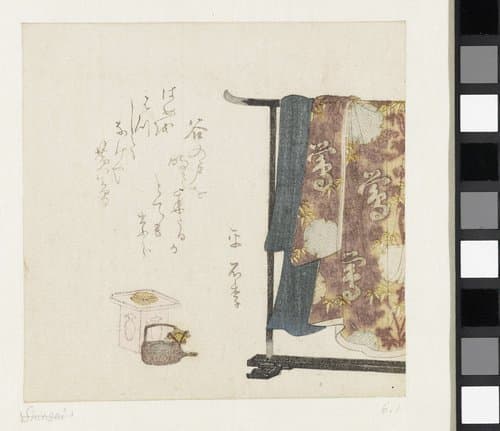
Kimono op een standaard
c. 1800 - c. 1805
Medium
nishikie, with metallic pigments
Dimensions
136; 139
Rights
Public Domain
About this artwork
blad: hoogte 136 mm x breedte 139 mm
Art Historical Context
**Kimono op een Standaard (c. 1800–1805)** This delicate anonymous print, titled *Kimono op een Standaard* (Kimono on a Stand), the elegance of Japanese fashion in a compact format—measuring just 136 mm high by 139 mm wide. Created during Japan's Edo period, it exemplifies *nishikie*, a sophisticated woodblock printing technique known as "brocade pictures" for their vibrant, luxurious appearance. The use of metallic pigments adds a shimmering, almost tactile quality, mimicking the iridescent sheen of fine silk fabrics and evoking the opulence of traditional kimonos. In early 19th-century Japan, kimonos were more than garments; they were canvases for artistic expression, reflecting seasonal motifs, social status, and cultural trends. Displaying a kimono on a stand highlights its aesthetic value as a standalone art object, a common theme in *ukiyo-e* prints that celebrated the "floating world" of beauty and transience. The metallic enhancements would have made this small sheet particularly prized, perhaps as a collector's item or fashion study. Though the artist remains unknown, the print's refined technique underscores the era's mastery of color layering and pigment innovation, bridging art and everyday luxury for admirers today.
About the Artist
anonymous
In the vast tapestry of art history, "Anonymous" stands not as a singular individual but as a collective designation for countless unidentified creators whose works have endured across millennia. These artists, spanning prehistoric cave painters to medieval illuminators and folk craftsmen, produced the foundational layers of human visual culture. Prior to the Renaissance, when individual fame emer...