
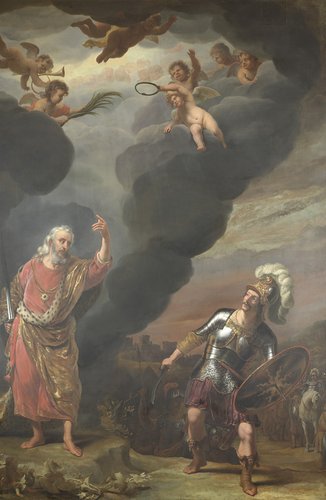
King Amaziah and the Man of God
1660 - 1663
Medium
oil on canvas
Dimensions
273; 408
Rights
Public Domain
About this artwork
Koning Amazia en de man Gods. De 'Vorst van het Heir des Heeren' verschijnt aan Jozua bij Jericho. Boven opent zich de hemel met engeltjes, waarvan er één een slang vasthoudt die in zijn staart bijt, het symbool van de eeuwigheid. Jozua gekleed in wapenrusting met een zwaard en schild in de handen. Onderdeel van een groep van vijf werken vervaardigd voor het huis aan de Nieuwegracht 6 te Utrecht.
Art Historical Context
Ferdinand Bol, leading Dutch Golden Age painter and former pupil of Rembrandt, created *King Amaziah and the of God* between 1660 and 1663. This monumental oil on canvas, measuring over 4 meters tall and nearly 3 meters wide, formed part of a lavish series of five biblical works commissioned for a grand house at Nieuwegracht in Utrecht. Such large-scale history paintings were prized in affluent 17th-century Dutch homes, blending spiritual narrative with opulent display to inspire moral reflection amid the era's prosperity. The composition dramatically captures a pivotal biblical moment: the "Prince of the Host of the Lord" appearing to Joshua at Jericho. Heaven parts above, revealing frolicking putti angels, one clutching a serpent biting its tail—the ancient ouroboros symbol of eternity. Joshua stands resolute in gleaming armor, sword and shield in hand, evoking divine intervention and heroic faith. Bol's Baroque technique shines through in his masterful use of chiaroscuro for theatrical light effects and rich, textured brushwork, refining Rembrandt's influence into a more elegant, luminous style. Housed today in Amsterdam's Rijksmuseum, this piece highlights Bol's skill in elevating scriptural stories into visually immersive spectacles, underscoring the cultural reverence for Old Testament tales in Protestant Netherlands.
About the Artist
Ferdinand Bol · 1616–1680
As a very young man, Bol moved to Amsterdam, where he worked under the direction of Rembrandt, with whom he formed a friendship. Comment on works: Religious; History; Portraits