
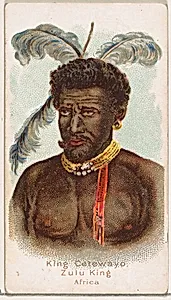
King Cetewayo, Zulu King, Africa, from the Savage and Semi-Barbarous Chiefs and Rulers series (N189) issued by Wm. S. Kimball & Co.
Medium
Commercial color lithograph
Dimensions
Sheet: 2 11/16 × 1 1/2 in. (6.8 × 3.8 cm)
Classification
Prints|Ephemera
Department
Drawings and Prints
Museum
Metropolitan Museum of Art, New York, NY
Credit
The Jefferson R. Burdick Collection, Gift of Jefferson R. Burdick
Accession Number
63.350.216.189.46
Rights
Public Domain
Tags
Art Historical Context
This vibrant chromolithograph, titled *King Cetewayo, King, Africa*, is tiny gem from 1888, produced by the American tobacco firm William S. Kimball & as part of their "Savage and Semibarous Chiefs and R" series (N189 Measuring just 2 11/16 × 1 1/2 inches, it served as an advertising trade card, likely distributed with cigarette packs to captivate collectors with exotic portraits. The series reflected late 19th-century Western fascination—and often patronizing attitudes—toward global leaders from Africa, Asia, and beyond, blending commerce with colonial-era curiosity. Cetewayo (also spelled Cetshwayo), the powerful Zulu king who ruled from 1872 to 1884, is depicted here in regal profile, symbolizing his historical defiance against British forces during the Anglo-Zulu War of 1879. His image captures a moment of global intrigue, as his forces famously triumphed at the Battle of Isandlwana before ultimate defeat. Such cards commodified these figures, turning real history into pocket-sized souvenirs. Printed via commercial color lithography—a groundbreaking technique for affordable, vivid mass production—this ephemera highlights how art intersected with consumer culture. Today, in the Metropolitan Museum of Art's Jefferson R. Burdick Collection, it offers a window into Victorian-era stereotypes and the Zulu monarch's enduring legacy.
About the Artist
William S. Kimball & Company · 1850–1950
**William S. Kimball & Company**, a pioneering American tobacco manufacturer, was established in 1846 in Rochester, New York, by William S. Kimball and James C. Hart. The firm quickly grew into one of the city's largest employers, particularly of women, producing popular brands like Peerless chewing tobacco, Rigatta and Fireside smoking tobacco, and Vanity Fair cigarettes. Under Kimball's leadersh...