
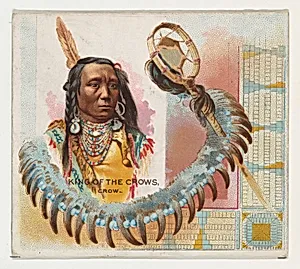
King of the Crows, Crow, from the American Indian Chiefs series (N36) for Allen & Ginter Cigarettes
1888
Medium
Commercial color lithograph
Dimensions
Sheet: 2 7/8 x 3 1/4 in. (7.3 x 8.3 cm)
Classification
Prints|Ephemera
Department
Drawings and Prints
Museum
Metropolitan Museum of Art, New York, NY
Credit
The Jefferson R. Burdick Collection, Gift of Jefferson R. Burdick
Accession Number
63.350.202.36.20
Rights
Public Domain
Tags
Art Historical Context
In the late 19th century, American tobacco companies like Allen & Ginter pioneered the use of trading cards to boost cigarette sales, turning everyday purchases into collectible treasures. "King of the Crows Crow," from the 1888 American Indian Chiefs series (N36), exemplifies marketing savvy. This petite chromolithograph (2 7/8 x 3 1/4 inches) portrays a Crow leader in a stylized portrait, capturing the era's fascination with Native American figures amid the fading frontier. Issued in sets of 50 cards, these vibrant prints romanticized indigenous leaders, blending portraiture with commercial ephemera. Chromolithography, the medium here, was a breakthrough in color printing, allowing mass production of vivid, multi-layered images from stone plates—a technique that made high-quality illustrations affordable and widespread. Allen & Ginter's cards, prized by collectors today, reflect how popular culture commodified Native identities, often prioritizing exoticism over accuracy. Housed in the Metropolitan Museum of Art's Jefferson R. Burdick Collection, this card highlights the intersection of advertising, art, and history. It invites us to reflect on how everyday objects preserved cultural narratives, offering a window into Gilded Age America's complex gaze on its indigenous peoples.
About the Artist
Allen & Ginter
Allen & Ginter, the pioneering American tobacco firm based in Richmond, Virginia, emerged around 1880 from the partnership of John F. Allen and Lewis Ginter, evolving from Allen's earlier John F. Allen & Company. Allen retired in 1882, succeeded by John Pope, yet the brand endured under Ginter's leadership, employing over 1,100 workers—mostly women—for hand-rolled cigarettes by 1886. Ginter, a Dut...