
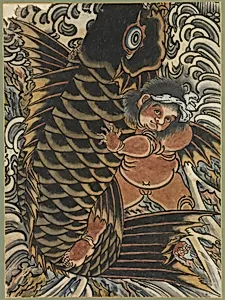
Kintaro with Carp
Unknown Artist
19th century
Medium
Hanging scroll; hand-colored woodblock print
Dimensions
Image: 23 3/4 x 17 1/2 in. (60.4 x 44.5 cm) Overall: 56 1/8 x 24 3/4in. (142.6 x 62.9 cm)
Classification
Paintings
Culture & Period
Japan · Edo period (1615–1868)
Department
Asian Art
Museum
Metropolitan Museum of Art, New York, NY
Credit
The Harry G. C. Packard Collection of Asian Art, Gift of Harry G. C. Packard, and Purchase, Fletcher, Rogers, Harris Brisbane Dick, and Louis V. Bell Funds, Joseph Pulitzer Bequest, and The Annenberg Fund Inc. Gift, 1975
Accession Number
1975.268.149
Rights
Public Domain
Tags
Art Historical Context
**Kintaro with Carp** is a captivating 19th-century hanging scroll Japan's Edo period (16151868), featuring the legendary boy hero Kintaro playfully wrestling a massive carp. Rendered as a hand-colored woodblock print, artwork exemplifies ukiyo-e techniques, where intricate woodblocks were carved to print layered colors, then meticulously hand-tinted for vibrant hues. The generous dimensions—image at 23¾ × 17½ inches, overall scroll 56⅛ × 24¾ inches—made it ideal for display in homes during festivals or as a decorative statement. Kintaro, a folk hero symbolizing superhuman strength and innocence, often appears in Japanese art wrestling animals like bears or fish, embodying youthful vigor and harmony with nature. The carp, a potent cultural emblem of perseverance (for its upstream battles to spawn), adds layers of symbolism here, celebrating resilience. Produced anonymously amid Edo's flourishing print culture, this piece reflects popular tastes for whimsical, moral tales accessible to all classes. Housed in the Metropolitan Museum of Art's Asian Art Department from The Harry G. C. Packard Collection, it invites visitors to ponder how everyday woodblock artistry preserved enduring myths, bridging folklore and fine art. (198 words)