
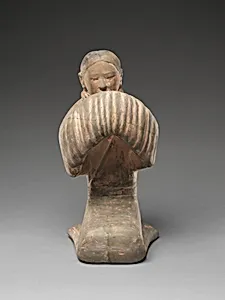
Kneeling Lady in Greeting Gesture
Unknown Artist
Medium
Earthenware with traces of pigments over white slip
Dimensions
H. 13 in. (33 cm); W. 6 1/4 in. (15.9 cm)
Classification
Tomb Pottery
Culture & Period
China · Western Han dynasty (206 B.C.–A.D. 9)
Department
Asian Art
Museum
Metropolitan Museum of Art, New York, NY
Credit
Gift of Charlotte C. Weber, 2000
Accession Number
2000.662.10
Rights
Public Domain
Tags
Art Historical Context
Welcome to the Asian Art galleries at the Metropolitan Museum of Art where we encounter the graceful *Kneeling Lady in Greeting Gesture*, a poignant example of Western Han dynasty (206 B.C.–A.D. 9) tomb. Crafted from earthenware, this 13-inch-high figurine a woman in a poised kneeling position, hands raised in a traditional greeting. Such mingqi, or spirit goods, were buried with the elite to serve the deceased in the afterlife, reflecting the Han belief in an eternal world mirroring daily life. The artistry shines through its medium: low-fired earthenware coated in white slip—a fine clay layer that created a smooth, porcelain-like surface for decoration—and traces of original pigments that once added vibrant color to her robes and features. This technique was innovative for the era, allowing mass production of detailed figures while preserving a sense of realism in her serene expression and flowing garments. Culturally, this piece offers a window into Han society, where female attendants symbolized hospitality and domestic harmony. Gifted by Charlotte C. Weber in 2000, she invites us to ponder the lives of everyday women in ancient China, frozen in eternal courtesy.