
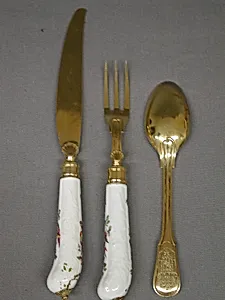
Knife
ca. 1750–60
Medium
Hard-paste porcelain, silver gilt
Dimensions
Length: 9 3/8 in. (23.8 cm)
Classification
Ceramics-Porcelain
Culture
German, Meissen
Department
European Sculpture and Decorative Arts
Museum
Metropolitan Museum of Art, New York, NY
Credit
Gift of Mr. and Mrs. Charles Wrightsman, 1976
Accession Number
1976.155.96
Rights
Public Domain
Art Historical Context
This exquisite porcelain knife from the Meissen Manufactory, dating to around 1750–60, exemplifies the pinnacle of 18th-century European decorative arts. Crafted during the height of the Rococo period, Meissen—Germany's pioneering porcelain factory founded in 1710—was renowned for mastering hard-paste porcelain, a durable, translucent material that rivaled prized Chinese imports. The knife's handle, formed from this fine white porcelain and accented with gleaming silver gilt, measures 9⅜ inches long, blending functionality with opulent ornamentation likely intended for a grand dining table service. Meissen's technical virtuosity shines here: the porcelain was fired at high temperatures for strength and vibrancy, then meticulously gilded with silver for a luxurious sheen. Such objects highlighted the manufactory's ability to transform everyday utensils into sculptural jewels, showcasing intricate molding and painting techniques that captured playful motifs like shells, foliage, or figures—hallmarks of Rococo's whimsical elegance. Commissioned by European aristocracy, pieces like this knife underscored porcelain's status as a symbol of wealth and innovation. Today, housed in the Metropolitan Museum of Art as a gift from Mr. and Mrs. Charles Wrightsman, it invites us to marvel at Meissen's enduring legacy in bridging craft and high art.
About the Artist
Meissen Manufactory · 1710–present
The Meissen Manufactory, established on June 6, 1710, by Augustus the Strong, Elector of Saxony and King of Poland, marked the dawn of true hard-paste porcelain production in Europe. Nestled at Albrechtsburg Castle in Meissen near Dresden, the Royal Polish and Electoral Saxon Porcelain Manufactory arose from alchemical experiments begun in 1708 by physicist Ehrenfried Walther von Tschirnhaus and p...