
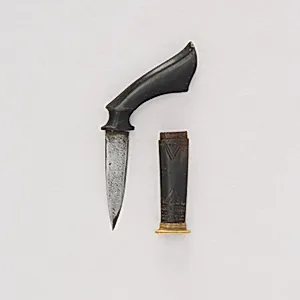
Knife with Sheath
Unknown Artist
18th–19th century
Medium
Horn, steel
Dimensions
L. with sheath 3 3/4 in. (9.5 cm); L. without sheath 3 5/8 in. (9.2 cm); W. 1 13/16 in. (4.6 cm); Wt. 0.4 oz. (11.3 g); Wt. of sheath 0.2 oz. (5.7 g)
Classification
Knives
Culture
Indonesian, Sulawesi, possibly Phillipine
Department
Arms and Armor
Museum
Metropolitan Museum of Art, New York, NY
Credit
Bequest of George C. Stone, 1935
Accession Number
36.25.1085a, b
Rights
Public Domain
Art Historical Context
This delicate **Knife with Sheath** 18th–19th Indonesia, likely Sulawesi with possible Philippine influences, exemplifies the exquisite craftsmanship of Southeast Asian arms makers. Crafted from horn and steel, the knife measures just 3¾ inches (9.5 cm) with its—compact enough for personal carry—featuring a slender blade and a handle shaped from polished horn, a material prized for its durability and natural beauty. The steel blade, honed to a fine edge, reflects advanced metallurgical skills honed over generations in island cultures where forging was both practical art and cultural necessity. In the rugged terrains of Sulawesi, such knives served multifaceted roles: tools for daily tasks like cutting betel nut or preparing food, yet also symbols of status and self-defense amid tribal conflicts and trade routes. The lightweight design (just 0.4 oz for the knife, 0.2 oz for the sheath) underscores portability, while the fitted horn sheath protected the edge and added ergonomic grace. Horn's use highlights sustainable material choices, often sourced from water buffalo, blending utility with subtle artistry. Now housed in The Metropolitan Museum of Art's Arms and Armor Department through the 1935 bequest of George C. Stone, this piece invites us to ponder the blurred lines between weapon, tool, and heirloom in precolonial Indonesia— a testament to enduring cultural ingenuity.