
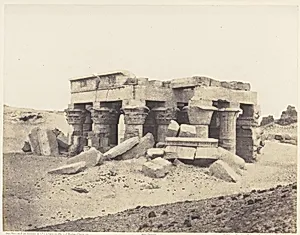
Kôm-Ombou (Ombos), Vue Générale des Ruines
1851–52, printed 1853–54
Medium
Salted paper print from paper negative
Dimensions
23.8 x 30.7 cm. (9 3/8 x 12 1/16 in.)
Classification
Photographs
Department
Photographs
Museum
Metropolitan Museum of Art, New York, NY
Credit
Purchase, Lila Acheson Wallace Gift, 1976
Accession Number
1976.607.79
Rights
Public Domain
Tags
Art Historical Context
Step into the sun-baked sands of ancient Egypt with Félix Teynard's *Kôm-Ombou (Ombos), Vue Générale des Ruines*, a captivating salted paper print from 1851–52, printed 1853–54. This 23.8 x 30.7 cm photograph captures a sweeping vista of the majestic ruins at Kom Ombo, a Ptolemaic temple complex on the Nile's east bank dedicated to the crocodile god Sobek and falcon-headed Haroeris. Teynard, a pioneering French photographer, documented these architectural marvels during a mid-19th-century expedition, blending scientific precision with artistic vision amid Europe's Egyptomania craze. Crafted via the calotype process—using a paper negative to produce a salted paper positive—this work exemplifies early photography's revolutionary negative-positive technique, invented by William Henry Fox Talbot. The soft tonal gradations and subtle details reveal intricate carvings and towering columns, preserving the site's grandeur for posterity long before modern restoration efforts. Acquired by The Metropolitan Museum of Art in 1976 through the Lila Acheson Wallace Gift, this print highlights photography's role in archaeology and Orientalist exploration, offering visitors a window into a vanishing world where light and shadow evoke the eternal mystery of the Nile Valley.
About the Artist
Félix Teynard|Imprimerie Photographique de H. de Fonteny et Cie · 1817–1892
**Félix Teynard (1817–1892)** was a pioneering French photographer whose work captured the ancient wonders of Egypt and Nubia with unprecedented precision and artistry. Born on January 14, 1817, in Saint-Flour, he trained as a civil engineer in Grenoble, a hub of Egyptology that likely sparked his fascination with ancient architecture. Little is documented about his early life or formal photograph...