
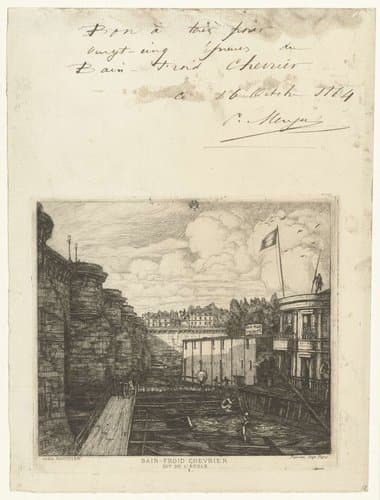
Koud-water badhuis van Chevrier in Parijs
1864
Medium
etching
Dimensions
130; 143
Rights
Public Domain
About this artwork
ets en droge naald
Art Historical Context
Charles Meryon’s *Koud-water badhuis Chevrier in Parijs (1864) captures a slice of everyday Parisian life in the mid-19th. This intimate etching depicts Chevrier’s cold-water bathhouse, a public facility offering invigorating hydrotherapy popular among the working class before modern plumbing transformed urban hygiene. Meryon, a master etcher renowned for his haunting views of old Paris, documented the city’s vanishing architecture just prior to Baron Haussmann’s sweeping renovations, preserving these scenes with meticulous detail. Rendered in etching combined with drypoint—a technique where the artist scratches directly into the metal plate for velvety, expressive lines—the 130 × 143 mm print showcases Meryon’s technical virtuosity. The etching process allowed precise architectural lines, while drypoint added rich, textured burrs that evoke atmosphere and depth, aligning with the 19th-century etching revival and Meryon’s proto-Impressionist sensitivity to light and shadow. This work holds cultural significance as part of Meryon’s seminal *Eaux-Fortes sur Paris* series, blending Romantic nostalgia with topographic precision. It invites viewers to linger on Paris’s hidden corners, reminding us of a time when public bathhouses were vital social hubs. A poignant artifact of pre-modern urban life!
About the Artist
Charles Meryon · 1821–1868
Charles Meryon, born on November 23, 1821, in Paris, was the illegitimate son of English physician Dr. Charles Lewis Meryon and dancer Pierre-Narcisse Chaspoux (stage name Narcisse Gentil) at the Paris Opéra. His half-sister Fanny, from his mother's prior relationship with Viscount Lowther, remained in contact after their mother's death in 1838. Raised partly outside Paris before attending Pension...