
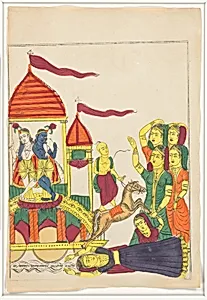
Krishna and Balarama depart Vrindavan
dated equivalent to 1856
Medium
Lithograph printed in black, with watercolor and selectively applied glaze
Dimensions
Sheet: 16 3/8 × 11 1/8 in. (41.6 × 28.3 cm)
Classification
Prints
Culture
West Bengal, Calcutta, Kalighat
Department
Asian Art
Museum
Metropolitan Museum of Art, New York, NY
Credit
Gift of Mark Baron and Elise Boisanté, 2021
Accession Number
2021.325.3
Rights
Public Domain
Art Historical Context
In the vibrant tradition of Kalighat art from 19th-century Calcutta,charam Das Dutta 1856 lithograph *Krishna and Bama Depart Vrindavan* captures poignant moment from Hindu mythology. The image depicts the divine brothers Krishna and Balarama bidding farewell to the idyllic village of Vrindavan where Krishna spent his youthful days herding cows, playing flute, and romancing the gopis. This departure symbolizes the transition from Krishna's playful childhood to his heroic adulthood, evoking themes of longing and divine destiny that resonate deeply in Bengali Vaishnava devotion. Originating from the Kalighat temple district in West Bengal, these affordable prints were produced by patuas—scroll painters turned commercial artists—for pilgrims and urban middle classes. Kalighat style is renowned for its bold black outlines, flat colors, and expressive simplicity, blending folk aesthetics with mass reproduction via lithography, which democratized sacred imagery during British colonial rule. Printed in black ink and hand-colored with watercolor and selective glazes, this 16⅜ × 11⅛ in. sheet exemplifies the medium's innovation: lithography allowed quick replication, while artisanal enhancements added luminous depth. Now in the Metropolitan Museum of Art's Asian Art collection, it highlights how Kalighat art preserved cultural narratives amid rapid modernization.