
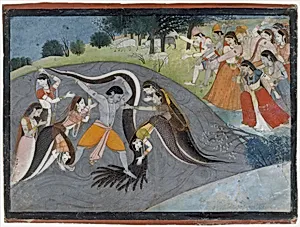
Krishna Subduing Kaliya, the Snake Demon: Folio from a Bhagavata Purana Series
Medium
Opaque watercolor and ink on paper
Dimensions
8 x 10 1/2 in. (20.3 x 26.7 cm)
Classification
Paintings
Culture
Northern India, Garwhal, Himachal Pradesh
Department
Asian Art
Museum
Metropolitan Museum of Art, New York, NY
Credit
Rogers Fund, 1927
Accession Number
27.37
Rights
Public Domain
Tags
About this artwork
Krishna Subduing Kaliya, the Snake Demon: Folio from a Bhagavata Purana Series by First generation after Manaku and Nainsukh, ca. 1785. Created in Opaque watercolor and ink on paper, this work exemplifies the artistic practices and cultural values of its period. The piece reflects the technical skills and aesthetic sensibilities characteristic of its historical and cultural context. As part of the Asian Art collection, it contributes to our understanding of artistic development and cultural expr...
Art Historical Context
This vibrant folio from a *Bhagavata Purana* series captures the dramatic moment when Krishna subdues Kaliya, the venomous multi-headed snake demon polluting the Yamuna River.rawn from Hindu mythology in the sacred *Bhagavata Purana* text, the scene depicts the young god Krishna triumphantly dancing on Kaliya's coils, surrounded by his devotees, gopis, and divine onlookers. Created around 1785 in Northern India's Garwhal and Himachal regions—heartlands of Pahari painting—this work reflects the devotional fervor of the Bhakti movement, blending spiritual narrative with exquisite visual storytelling. Attributed to artists of the first generation following the master Pahari painters Manaku and Nainsukh, the piece showcases the refined Guler-Kangra style's hallmark delicacy. Opaque watercolor and ink on paper, a medium perfected in Indian miniatures, allow for luminous colors, intricate details, and dynamic compositions within its modest 8 x 10½-inch format. Figures flow with graceful poise, serpentine forms writhe vividly, and the palette of vivid blues, greens, and golds evokes the mythical river's life force. As part of the Metropolitan Museum of Art's Asian Art collection (acquired via the Rogers Fund in 1927), this painting illuminates 18th-century Pahari artistic innovation, bridging Basohli boldness with Kangra lyricism. It not only preserves a timeless tale of divine heroism but also invites viewers to ponder themes of harmony with nature and triumph over chaos.