
Kärnthner-Ring No. 12, Zinshaus des Grafen F. Abensberg und Traun
1860s
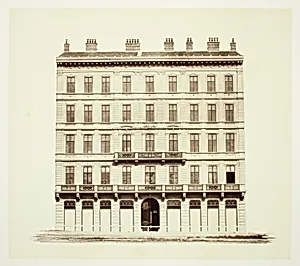
Medium
Albumen print
Dimensions
Image/paper: 29.4 × 33.2 cm (11 5/8 × 13 1/8 in.); Album page: 42.7 × 61.2 cm (16 13/16 × 24 1/8 in.)
Classification
photograph
Department
Photography and Media
Museum
Art Institute of Chicago
Accession Number
234507
Rights
Public Domain
Art Historical Context
Step into 1860s Vienna with this captivating albumen print, *Kärnthner-Ring No. 12, Zinshaus des Graf F. Abensberg und Traun*. Captured an anonymous photographer, it a grand rental house (Zinshaus) owned by Count Franz Abensberg und Traun on the bustling Kärnthner Ring, part of the city's transformative Ringstraße project. Emperor Franz Joseph I's ambitious urban renewal demolished medieval walls to create a monumental boulevard lined with opulent architecture, symbolizing Vienna's emergence as a modern imperial capital. This image freezes a moment of that gilded era, showcasing the building's ornate facade amid the neighborhood's vibrant street life. The albumen print medium, dominant in mid-19th-century photography, reveals the era's technical prowess. Coated with egg whites to hold light-sensitive silver salts, it yields richly toned, finely detailed images ideal for architectural documentation—far sharper than earlier daguerreotypes. Measuring nearly 30 x 33 cm, this print was likely mounted in a lavish album for collectors, highlighting photography's role in preserving urban evolution before widespread postcard culture. Housed in the Art Institute of Chicago's Photography and Media department, this anonymous work underscores how early photos democratized views of elite spaces, bridging art and history for today's visitors. A window to Vienna's architectural renaissance! (198 words)
About the Artist
Anonymous
In the vast tapestry of art history, "Anonymous" stands not as a singular individual but as a collective designation for countless unidentified creators whose works have endured across millennia. These artists, spanning prehistoric cave painters to medieval illuminators and folk craftsmen, produced the foundational layers of human visual culture. Prior to the Renaissance, when individual fame emer...