
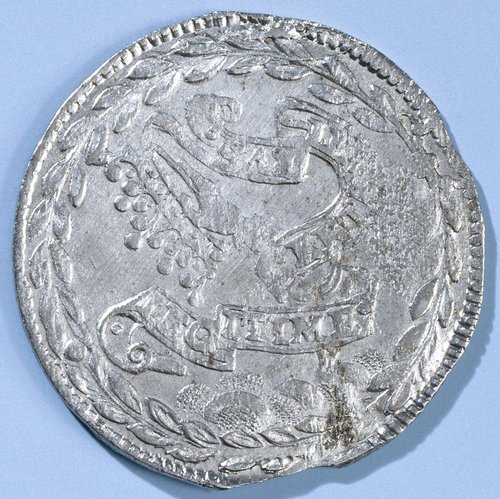
Kroning van Ferdinand II tot Duits keizer te Frankfurt
1619
Medium
striking (metalworking)
Dimensions
1.83; 2.2
Rights
Public Domain
About this artwork
diameter 2.2 cm x weight 1.83 gr
Art Historical Context
Behold this exquisite miniature medal, *Kroning van Ferdinand tot Duits keizer te* (Coronation of Ferdinand as Holy Roman Emperor in), crafted anonymously in 1619. just 2.2 cm in diameter and weighing a mere 1.83 grams, it captures a pivotal moment in European history: the election and coronation of Ferdinand, Archduke of Austria and a staunch Habsburg Catholic, as Holy Roman Emperor in Frankfurt am Main. Struck at the outset of the Thirty Years' War (1618–1648), this tiny artwork served as a commemorative token, likely distributed to mark the imperial ceremony amid religious and political turmoil. Ferdinand's ascension intensified Protestant-Catholic tensions across the Holy Roman Empire, setting the stage for one of Europe's most devastating conflicts. Such medals were popular in the early modern period, blending propaganda, piety, and prestige to celebrate rulers and events. The medium of striking— a precise metalworking technique involving dies to imprint intricate relief designs—allowed for remarkable detail on this diminutive scale. Though anonymous, the artisan's skill reflects the era's mastery of numismatic art, where small objects carried immense symbolic weight. A delightful piece for collectors, it invites us to ponder the grand dramas encoded in the tiniest treasures.
About the Artist
anonymous
In the vast tapestry of art history, "Anonymous" stands not as a singular individual but as a collective designation for countless unidentified creators whose works have endured across millennia. These artists, spanning prehistoric cave painters to medieval illuminators and folk craftsmen, produced the foundational layers of human visual culture. Prior to the Renaissance, when individual fame emer...