
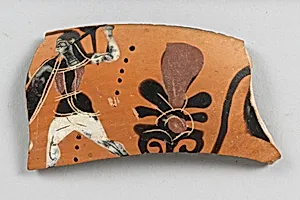
Kylix, band-cup fragment
3rd quarter of the 6th century BCE
Medium
Terracotta
Dimensions
greatest length 5.89 cm.
Classification
Vases
Culture & Period
Greek, Attic · Archaic
Department
Greek and Roman Art
Museum
Metropolitan Museum of Art, New York, NY
Credit
Gift of Dietrich von Bothmer, 1954
Accession Number
54.12.2
Rights
Public Domain
Art Historical Context
This delicate fragment from a *kylix*—a shallow drinking cup popular in ancient symposia—offers a glimpse into Archaic Greek artistry from Attica, circa 560–550 BCE. Crafted by the Wraith Painter, a master of the black-figure technique, it hails from the vibrant workshop culture of 6th-century Athens. As part of a band-cup subtype, its decoration likely featured a narrow horizontal band of figures around the vessel's body, a hallmark of the artist's precise, narrative style depicting myths, athletes, or daily life against the warm terracotta clay. Terracotta, fired clay painted with glossy black slip, was the medium of choice for these durable yet elegant vases, revealing the evolution from geometric patterns to dynamic human forms in Archaic pottery. The Wraith Painter's subtle incised details—outlines and interior patterns scratched through the black slip—highlight technical innovation, bridging earlier rigid styles toward the fluidity of later red-figure work. Though only 5.89 cm long, this shard captures the period's cultural pulse: vessels like these fueled social rituals, preserving stories for eternity. Generously gifted to the Metropolitan Museum of Art in 1954 by Dietrich von Bothmer, the fragment invites us to ponder the hands that once raised such cups in revelry, echoing the ingenuity of ancient Greek artisans.