
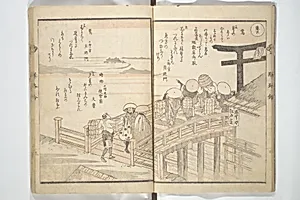
狂歌東関駅路鈴|Kyōka Poems as Chimes along the Tōkaidō (Kyōka tokan ekiro no suzu 狂歌東関駅路鈴)
1830 (Bunsei 13)
Medium
Woodblock printed book; ink and color on paper
Dimensions
9 × 6 5/16 in. (22.8 × 16 cm)
Classification
Illustrated Books
Culture & Period
Japan · Edo period (1615–1868)
Department
Asian Art
Museum
Metropolitan Museum of Art, New York, NY
Credit
Purchase, Mary and James G. Wallach Foundation Gift, 2013
Accession Number
2013.705
Rights
Public Domain
Tags
Art Historical Context
Step into the vibrant world of Edo-period Japan with *Kyōka Poems as Chimes the Tōkaidō* (1830), a delightful woodblock-printed book by Totoya Hokkei, a skilled ukiyo-e artist and of the famed Katsushika Hokusai. Created during the Bunsei era, this compact volume (9 × 6 5/16 in.) the spirit of travel along the Tōkaidō, the historic coastal highway linking Edo (modern Tokyo) to Kyoto. Its title evokes the rhythmic chimes of station bells, mirrored in kyōka—witty, satirical poems that playfully parody traditional waka verse. Hokkei's illustrations burst with color and ink on paper, depicting lively scenes of bridges, horses, boats, and human figures bustling at post stations. These images reflect the era's fascination with *ukiyo* (the floating world) of journeys, merchants, and everyday adventures, a popular theme in Japanese print culture. Woodblock printing allowed for affordable, mass-produced books like this, making sophisticated art accessible to a wide audience beyond elites. This treasure from the Metropolitan Museum of Art highlights kyōka's cultural role in Edo humor and social commentary, blending poetry and visuals in a portable format perfect for travelers. A charming snapshot of 19th-century Japan's wanderlust!
About the Artist
Totoya Hokkei 魚屋北渓 (Japanese) · 1780 –1850
Japanese, 1780–1850