
Kyōsai’s Drawings for Pleasure (Kyōsai rakuga) 暁齋樂画
1881, seventh month (Meiji 14)
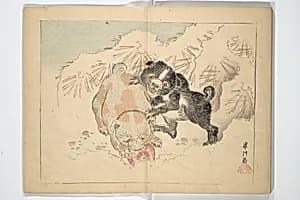
Medium
Set of two woodblock-printed books (one volume orihon, accordion-style); ink and color on paper
Dimensions
each: 8 7/8 × 5 7/8 in. (22.5 × 15 cm)
Classification
Illustrated Books
Culture & Period
Japan · Meiji period (1868–1912)
Department
Asian Art
Museum
Metropolitan Museum of Art, New York, NY
Credit
Purchase, Mary and James G. Wallach Foundation Gift, 2013
Accession Number
2013.766a, b
Rights
Public Domain
Tags
Art Historical Context
Step into the whimsical world of Kawanabeōsai with *Kyōsai’s for Pleasure (Kyōai rakuga)*, a delightful set of two woodblock books created in the seventh month of 1881 during Japan's Meiji period (1868–1912). Kyōsai, a master of ukiyo-e and ink painting renowned for his satirical humor and fantastical imagery, produced these accordion-style orihon volumes—measuring a compact 8⅞ × 5⅞ inches each—using vibrant ink and color on paper. This intimate format invited viewers to unfold pages like a playful scroll, revealing spontaneous sketches that capture the artist's boundless creativity. Kyōsai's *rakuga*, or "drawings for pleasure," embody his signature style: lively, irreverent doodles blending traditional Japanese techniques with exuberant energy. Amid Meiji Japan's rapid Westernization, these works celebrate unbridled joy through scenes of frolicking animals at play, poking fun at human follies while showcasing masterful woodblock printing. The precision of the medium—layered colors and bold lines—highlights the tension between structured craftsmanship and Kyōsai's free-spirited improvisation, making it a cultural gem of Edo-period wit enduring into modern times. Housed in the Metropolitan Museum of Art's Asian Art Department, this 2013 acquisition invites us to appreciate Kyōsai's enduring legacy as Japan's "last great ukiyo-e artist," reminding visitors that art can be both profound and profoundly fun.
About the Artist
Kawanabe Kyōsai 河鍋暁斎 (Japanese) · 1831 –1889
Japanese, 1831–1889