
河鍋暁斎画 『暁斎漫画』|Kyōsai Sketchbook (Kyōsai manga) 暁斎漫画
1881 (Meiji 14)
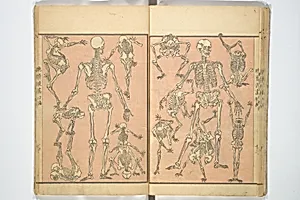
Medium
Woodblock printed book; ink and color on paper
Dimensions
8 3/4 × 5 7/8 in. (22.3 × 15 cm)
Classification
Illustrated Books
Culture & Period
Japan · Meiji period (1868–1912)
Department
Asian Art
Museum
Metropolitan Museum of Art, New York, NY
Credit
Purchase, Mary and James G. Wallach Foundation Gift, 2013
Accession Number
2013.765
Rights
Public Domain
Tags
Art Historical Context
Kawanabe Kyōsai’s *Kyōsai Sketchbook* (*Kyōsai manga*), published in 1881 during Japan’s Meiji period captures the artist’s lively imagination in a compact woodblock-printed format. Measuring just 8¾ by 5⅞ inches, this illustrated book showcases Kyōsai’s signature blend of humor and the macabre, with skeletons dancing, playing instruments, and engaging in everyday activities. The Meiji era’s rapid modernization provided fertile ground for such playful yet subversive imagery, allowing traditional motifs to meet a newly cosmopolitan audience. As a woodblock-printed book, the work exemplifies the enduring vitality of Japanese print culture even as photography and lithography began to emerge. Kyōsai, trained in both classical painting and popular ukiyo-e traditions, used the sketchbook format to experiment freely, turning the skeleton—a symbol often linked to impermanence—into a source of wit and energy. Visitors today can appreciate how these small pages preserve the spontaneous spirit of an artist celebrated for bridging Edo-period exuberance with Meiji innovation.
About the Artist
Kawanabe Kyōsai 河鍋暁斎 (Japanese) · 1831 –1889
Japanese, 1831–1889