
L'Oeuvre D'Antoine Watteau Pientre du Roy en son Academie Roïale de Peinture et Sculpture Gravé d'après ses Tableaux & Desseins originaux...par les Soins de M. de Jullienne, Volume III
ca. 1740
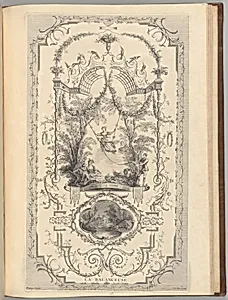
Medium
Engraving
Dimensions
Book: 25 3/16 × 19 1/2 × 1 15/16 in. (64 × 49.5 × 5 cm) Plate: 16 15/16 x 12 5/16 in. (43 x 31.2 cm)
Classification
Prints
Department
Drawings and Prints
Museum
Metropolitan Museum of Art, New York, NY
Credit
Gift of Mr. and Mrs. Herbert N. Straus, 1928
Accession Number
28.113(3)
Rights
Public Domain
Tags
Art Historical Context
Step into the enchanting world of Antoine Watteau the celebrated French Rococo master, through *L'Oeuvre d'Ant Watteau*, Volume III (ca. 1740). This lavish engraving, part of a monumental posthumous catalog overseen by Watteau's devoted friend and patron, Jean de Jullienne, the artist's original paintings and drawings remarkable fidelity. Produced as "Peintre du Roy" in the Académie Royale de Peinture Sculpture, Watteau's fêtes galantes and intimate figure studies captivated 18th-century Europe, blending theatrical elegance with subtle melancholy. Printed two decades after Watteau's early death in 1721, this volume—measuring a substantial 25 3/16 × 19 1/2 inches—served as one of the earliest comprehensive *oeuvres* of a living artist's legacy, making his works accessible beyond elite collectors. The 16 15/16 × 12 5/16-inch plate exemplifies the engraver's skill in translating Watteau's fluid brushwork and luminous color into intricate lines, preserving the graceful anatomy of male and female nudes that reveal his fascination with the human form's poetic vulnerability. Housed in The Metropolitan Museum of Art's Drawings and Prints department (gift of Mr. and Mrs. Herbert N. Straus, 1928), this print not only disseminates Rococo's playful sensuality but also underscores engraving's role in art history as a democratic medium, bridging Watteau's aristocratic visions to a broader audience.
About the Artist
Antoine Watteau · 1684–1721
Jean-Antoine Watteau, born in 1684 in Valenciennes to a modest family—his father a roofer named Jean-Philippe Watteau—was the second of four sons who displayed an early passion for art. After initial apprenticeship under local painter Jacques-Albert Gérin, he moved to Paris around 1702, working in workshops copying Flemish and Dutch genre scenes. By 1705, he entered the studio of Claude Gillot, ab...