
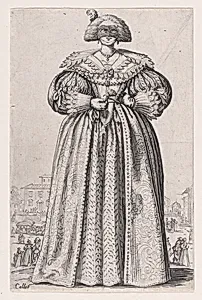
La Dame au Masque (The Lady with a Mask), from La Noblesse (The Nobility)
ca. 1623
Medium
Etching
Dimensions
Sheet: 5 11/16 x 3 3/4 in. (14.4 x 9.5 cm)
Classification
Prints
Department
Drawings and Prints
Museum
Metropolitan Museum of Art, New York, NY
Credit
Bequest of Edwin De T. Bechtel, 1957
Accession Number
57.650.347(1)
Rights
Public Domain
Tags
Art Historical Context
**La Dame au MasqueThe Lady with a Mask, created by the masterful French printmaker Jacques Callot around 1623, is a captivating etching from his series *La Noblesse (The Noblesse)*. This intimate sheet, measuring just 5 11/16 x 3 3/4 inches, depicts an elegant noblewoman adorned with an elaborate mask, evoking the opulent world of 17th-century aristocracy. Callot, a pioneer of Baroque etching who worked at the Medici court in Florence specialized in these small-scale, highly detailed prints that captured the splendor of costumes and social rituals with astonishing precision. Etching allowed Callot to achieve intricate lines and textures, rendering the lady's flowing gown, feathered headdress, and enigmatic mask with lifelike finesse. Masks were fashionable accessories in courtly life, symbolizing mystery, disguise, and festivity—often linked to carnivals, balls, and the theatrical flair of Commedia dell'arte. This piece reflects the era's fascination with nobility's grandeur amid the opulent courts of France and Italy, where appearance was paramount. Housed in the Metropolitan Museum of Art's Drawings and Prints department through the bequest of Edwin De T. Bechtel in 1957, *La Dame au Masque* showcases Callot's enduring influence on printmaking, blending artistry with social commentary on class and performance. A delightful glimpse into a masked world of intrigue! (198 words)
About the Artist
Jacques Callot · 1592–1635
Jacques Callot (1592–1635) was a French printmaker and draftsman from the Duchy of Lorraine, widely regarded as one of the first great artists to practice the graphic arts exclusively. His more than 1,400 etchings chronicled the breadth of 17th-century life, from Medici court festivities to the brutal realities of warfare. Callot revolutionized etching through technical innovations including the é...