
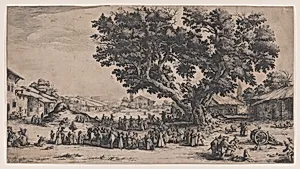
La Fiore de Gondreville pièce appelée aussi La Fête du Village, La Petite Foire, Le Bal Champêtre, Le Jeu de Boules (The Fair at Gondreville also called The Village Festival, The Little Fair, The Country Dance, The Game of Bowls)
17th century
Medium
Etching
Dimensions
Sheet: 7 3/16 x 13 in. (18.2 x 33 cm)
Classification
Prints
Department
Drawings and Prints
Museum
Metropolitan Museum of Art, New York, NY
Credit
Harris Brisbane Dick Fund, 1947
Accession Number
47.100.631
Rights
Public Domain
Art Historical Context
Jacques Callot's *La Foire de Gondreville (also known as *The Village Festival*, * Little Fair*, *The Dance*, or *The of Bowls*), a 17th-century etching, the lively spirit of rural French festivities. Created during the Baroque era, this depicts a bustling village fair in Gondreville, likely showcasing peasants engaged in dances, games like boules, and communal merrymaking. Callot, a master printmaker from Lorraine, excelled at portraying such crowded scenes, drawing from his travels across Europe and keen observation of everyday life. The etching medium allowed Callot to achieve extraordinary detail in a compact sheet of 7 3/16 x 13 inches (18.2 x 33 cm). His innovative use of multiple biting techniques produced fine, varied lines that convey depth, movement, and intricate patterns of clothing and architecture amid the throng. This work exemplifies his "fairground" series, blending social commentary with technical virtuosity, influencing later artists like Rembrandt. Housed in the Metropolitan Museum of Art's Drawings and Prints department (Harris Brisbane Dick Fund, 1947), it offers a vivid window into 17th-century European folk culture, celebrating the joy and chaos of village life before the rigid formalities of courtly art dominated. A delightful snapshot of human connection through play.
About the Artist
Jacques Callot · 1592–1635
Jacques Callot (1592–1635) was a French printmaker and draftsman from the Duchy of Lorraine, widely regarded as one of the first great artists to practice the graphic arts exclusively. His more than 1,400 etchings chronicled the breadth of 17th-century life, from Medici court festivities to the brutal realities of warfare. Callot revolutionized etching through technical innovations including the é...