
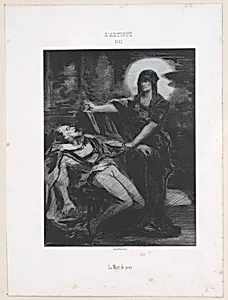
La Mort de peur
Medium
Lithograph
Dimensions
Image: 7 15/16 × 6 1/8 in. (20.1 × 15.5 cm) Sheet: 11 11/16 × 8 11/16 in. (29.7 × 22.1 cm)
Classification
Prints
Department
Drawings and Prints
Museum
Metropolitan Museum of Art, New York, NY
Credit
Harris Brisbane Dick Fund, 1928
Accession Number
28.93.16
Rights
Public Domain
Art Historical Context
**La Mort de Peur** (*Death from Fear*), a compelling lithograph by Narcisseirgile Diaz de Peña, possibly in collaboration with Bertauts, the dramatic essence of 19th-centuryism. Created between 1830 and 1876, this print hails from the active period of Diaz, a French artist renowned for his lush, poetic landscapes and figure studies influenced by the Barbizon school Though best known for oil paintings evoking nature's wild beauty, Diaz excelled in printmaking, using lithography to disseminate his evocative imagery to a wider audience during an era when affordable reproductions democratized art. Lithography, a revolutionary technique invented in the late 18th century, allowed Diaz to achieve rich tonal effects and fluid lines directly from a prepared stone, mimicking the spontaneity of drawing. Measuring just 7 15/16 × 6 1/8 inches, this intimate image likely depicts a moment of intense emotion—perhaps a figure overcome by terror—reflecting Romantic themes of mortality and the sublime. Acquired through the Harris Brisbane Dick Fund in 1928, it resides in the Metropolitan Museum of Art's Drawings and Prints department, highlighting the medium's role in preserving ephemeral artistic visions. This work invites visitors to ponder fear's grip on the human spirit, a timeless motif rendered with Diaz's signature delicacy. A testament to lithography's golden age, it bridges fine art and popular culture, offering a window into 19th-century sensibilities.