
La Petite Thèse estampe appelée aussi Le Triomphe de La Vierge et Jubilé de La Vierge (The Small Thesis, also called The Triumph o fthe Virgin and Jubilee of the Virgin)
May, 1625
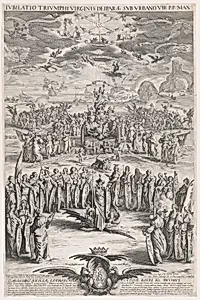
Medium
Etching; third state of three (Lieure)
Dimensions
Sheet: 21 7/8 x 14 3/8 in. (55.6 x 36.5 cm)
Classification
Prints
Department
Drawings and Prints
Museum
Metropolitan Museum of Art, New York, NY
Credit
Bequest of Edwin De T. Bechtel, 1957
Accession Number
57.650.602
Rights
Public Domain
Art Historical Context
Created in May 1625 by Jacques Callot and Israel Silvestre, this large etching—known as both *La Petite Thèse* and *The Triumph of the Virgin*—depicts a celebratory religious scene honoring the Virgin Mary. The dual titles suggest it commemorated a jubilee or academic thesis defense, common events in Counter-Reformation Europe where art reinforced Catholic devotion. Measuring nearly 22 by 14 inches, the sheet was designed for prominent display rather than private study. As an etching in its third and final state, the work showcases the medium’s ability to render intricate details and dramatic compositions that could be reproduced and shared widely. Callot, a leading figure in early seventeenth-century printmaking, brought his characteristic precision to the scene, while the collaboration with Silvestre reflects the collaborative nature of print production at the time. Today in the Metropolitan Museum of Art’s collection, the print stands as a vivid example of how Baroque-era artists used etching to blend spiritual themes with technical innovation, making grand religious imagery accessible beyond the walls of churches and courts.
About the Artist
Jacques Callot|Israel Silvestre · 1592–1635
Jacques Callot (1592–1635) was a French printmaker and draftsman from the Duchy of Lorraine, widely regarded as one of the first great artists to practice the graphic arts exclusively. His more than 1,400 etchings chronicled the breadth of 17th-century life, from Medici court festivities to the brutal realities of warfare. Callot revolutionized etching through technical innovations including the é...