
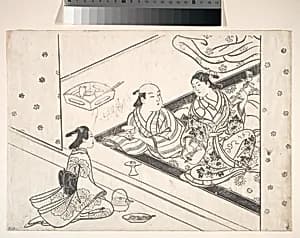
Lady Playing Shamisen, with Her Lover and Attendant Nearby
Medium
Monochrome woodblock print; ink on paper
Dimensions
H. 10 3/16 in. (25.9 cm); W. 14 1/2 in. (36.8 cm)
Classification
Prints
Culture & Period
Japan · Edo period (1615–1868)
Department
Asian Art
Museum
Metropolitan Museum of Art, New York, NY
Credit
H. O. Havemeyer Collection, Bequest of Mrs. H. O. Havemeyer, 1929
Accession Number
JP1585
Rights
Public Domain
Tags
Art Historical Context
This monochrome woodblock print by Nishikawa Sukenobu captures an intimate domestic moment from Japan’s Edo period (1615–1868). A woman plays the shamisen while her lover and attendant sit nearby, their relaxed postures suggesting quiet companionship. Rendered in delicate ink on paper, the composition graceful gestures and the instrument’s elegant, inviting viewers to imagine soft strains of music filling the room. Woodblock prints like this one were a hallmark of Edo visual culture, making art widely accessible beyond elite circles. Sukenobu’s focus on everyday interactions among women, men, and lovers reflects the period’s growing interest in scenes of urban life and personal relationships. The horizontal format encourages the eye to move across the figures, highlighting both individual expressions and the shared atmosphere they create. Housed in the Metropolitan of Art’s Asian Art collection as part of the H. O. Haveyer Bequest, the print preserves a fleeting glimpse of Edo-era leisure. Its modest scale and restrained palette underscore the quiet beauty of music and human connection in traditional Japanese society.
About the Artist
Nishikawa Sukenobu · 1671–1751
Japanese, 1671–1750