
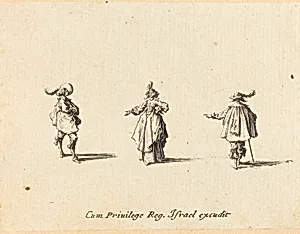
Lady with Outstretched Arm, and Two Gentlemen
c. 1633/1634
Medium
etching on laid paper
Dimensions
sheet (trimmed to plate mark): 6.2 × 8.2 cm (2 7/16 × 3 1/4 in.)
Classification
Department
CG-E
Museum
National Gallery of Art, Washington, D.C.
Credit
Rosenwald Collection
Accession Number
1949.5.222
Rights
Public Domain
Art Historical Context
Behold the delicate etching *Lady with Outstretched Arm and Two Gentlemen* by Jacques Callot, around 1633–1634. This intimate work, measuring just 6.2 × 8.2 cm on laid paper, captures a lively moment with a gesturing lady and two attentive gentlemen, rendered in Callot's signature intricate style. Housed in the National Gallery of Art's Rosen Collection, it exemplifies the French artist's mastery of the print medium the Baroque era. Callot, a pioneering etcher from Lorraine, revolutionized printmaking with his ability to pack extraordinary detail into tiny formats. Working at courts in Florence and Nancy, he drew inspiration from Italian mannerism and theatrical scenes, producing series of small-scale genre prints that buzzed with movement and character. His etching technique—using fine needles and acid bites for crisp lines and textures—allowed for multiple states and subtle tonal effects, making this work a technical marvel despite its trimmed sheet size. In the turbulent 1630s, amid the Thirty Years' War, Callot's whimsical vignettes offered escapist charm, blending social observation with virtuoso draftsmanship. This piece invites viewers to lean in close, discovering the artist's playful narrative in every etched flourish—a testament to etching's power as an accessible art form for collectors and connoisseurs alike.
About the Artist
Jacques Callot · 1592–1635
Jacques Callot (1592–1635) was a French printmaker and draftsman from the Duchy of Lorraine, widely regarded as one of the first great artists to practice the graphic arts exclusively. His more than 1,400 etchings chronicled the breadth of 17th-century life, from Medici court festivities to the brutal realities of warfare. Callot revolutionized etching through technical innovations including the é...