
Lady with Plumes, and Two Gentlemen
c. 1633/1634
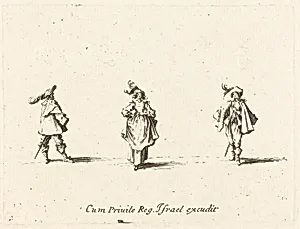
Medium
etching on laid paper
Dimensions
plate: 6.1 × 8.3 cm (2 3/8 × 3 1/4 in.) sheet: 8.1 × 10.3 cm (3 3/16 × 4 1/16 in.)
Classification
Department
CG-E
Museum
National Gallery of Art, Washington, D.C.
Credit
R.L. Baumfeld Collection
Accession Number
1969.15.811
Rights
Public Domain
Art Historical Context
In the intimate etching *Lady with Plumes, Two Gentlemen* (c. 1633/1634), Jacques Call captures a moment of 17th-century elegance with his signature precision. Created on laid paper, this tiny plate—measuring just 6.1 × 8.3 cm—showcases a fashionably attired lady adorned with feathers, flanked by two gentlemen ruffled collars and cloaks. Callot, a master printmaker from Lorraine who worked at the Medici court in Florence was renowned for his Baroque-era etchings that blended intricate detail with social observation. Etching allowed Callot to achieve extraordinary finesse through multiple acid bites on the metal plate, producing delicate lines that evoke texture in lace, plumes, and fabric folds. This technique revolutionized printmaking, enabling affordable dissemination of high-art imagery to collectors across Europe during the turbulent Thirty Years' War era. The work likely belongs to one of his whimsical series depicting contemporary manners and attire, offering a glimpse into the opulent world of courtly fashion. Housed in the National Gallery of Art's R.L. Baumfeld Collection, this print exemplifies Callot's virtuosity in miniaturization—crowding rich narrative into a space smaller than a modern postcard. It invites visitors to marvel at how such small-scale artistry preserved fleeting cultural moments for posterity.
About the Artist
Jacques Callot · 1592–1635
Jacques Callot (1592–1635) was a French printmaker and draftsman from the Duchy of Lorraine, widely regarded as one of the first great artists to practice the graphic arts exclusively. His more than 1,400 etchings chronicled the breadth of 17th-century life, from Medici court festivities to the brutal realities of warfare. Callot revolutionized etching through technical innovations including the é...