
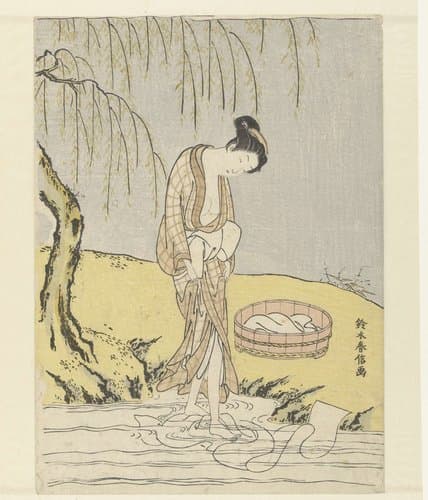
Laken wassende vrouw
1765 - 1770
Medium
color woodcut
Dimensions
274; 200
Rights
Public Domain
About this artwork
kleurenhoutsnede; lijnblok in zwart met kleurblokken
Art Historical Context
Suzuki Harunobu's *Laken wassende vrouw*ca. 1765–1770) is a delicate color wood print, measuring 274 × 200 mm, exempl the ukiyo-e tradition of Japan's Edo period. Harunobu (1725–1770), a master of the "pictures of the floating world," pioneered full-color woodblock printing (nishiki-e) 1765, transforming single-color techniques into vibrant, multi-hued masterpieces. This print a classic process: a black line block for precise outlines, overlaid with separate color blocks to layer subtle pigments, creating a luminous effect on washi paper. The title, translating roughly to "Woman Washing Linen," likely depicts a graceful bijin-ga (beautiful woman) in an intimate daily scene—a hallmark of Harunobu's oeuvre. His works often captured elegant women in serene, everyday moments, blending eroticism with poetic refinement and influencing later artists like Utamaro and Hokusai. Culturally, such prints were affordable luxuries for urban Edoites, democratizing art amid Japan's flourishing merchant class. This piece highlights Harunobu's technical innovation and enduring appeal, offering a window into 18th-century Japanese aesthetics where beauty intertwined with the ephemeral joys of life.
About the Artist
Suzuki Harunobu · 1725–1770
Suzuki Harunobu (c. 1725-1770) was a Japanese ukiyo-e artist who revolutionized woodblock printing by developing nishiki-e—full-color prints using multiple woodblocks—in 1765. Before Harunobu, Japanese prints were limited to two or three colors; his innovation unleashed the entire artist's palette, transforming ukiyo-e into the vibrant art form that would later captivate Western artists from Manet...