
Lamp
Unknown Artist
before 1271
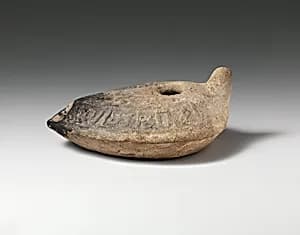
Medium
Earthenware
Dimensions
H. 2 1/16 in. (5.2 cm); W. 4 5/8 in. (11.7 cm); D. 3 1/8 in. ( 8 cm)
Classification
Miscellaneous
Culture
Syrian
Department
Arms and Armor
Museum
Metropolitan Museum of Art, New York, NY
Credit
Gift of Clarence H. Mackay, Archer M. Huntington, Stephen H. P. Pell and Bashford Dean, 1928
Accession Number
28.99.16
Rights
Public Domain
Art Historical Context
This delicate earthenware lamp, crafted by an unknown Syrian artist before 127, offers a glimpse into everyday life in medieval Syria. Measuring just over 2 inches tall and4.5 inches wide, its compact form—typical of oil lamps from the Islamic world—suggest it was designed for portable illumination, perhaps in homes, mosques, or travelers' camps. Made from fired clay, earthenware was a practical, affordable medium prized for its durability and ease of production, allowing artisans to shape simple, functional vessels on potter's wheels before low-temperature firing. Dating to the Ayyubid or early Mamluk period, when Syria thrived as a cultural crossroads under Muslim rule amid Crusader incursions and Mongol threats, this lamp reflects the region's vibrant ceramic traditions. Such objects were ubiquitous, fueled by olive oil and wicks, and often featured in domestic rituals or religious settings. Its placement in the Metropolitan Museum of Art's Arms and Armor Department hints at a possible military or nomadic context, evoking the portable necessities of soldiers or merchants navigating the Silk Road trade routes. Though unadorned, this modest artifact underscores the ingenuity of Syrian potters, whose unglazed earthenware balanced utility with subtle artistry. Gifted to the Met in 1928, it invites us to ponder the quiet glow it once cast in a turbulent era, bridging ancient craftsmanship with our modern curiosity.