
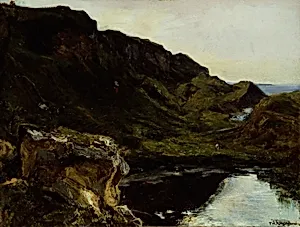
Landscape
c. 1835
Medium
Oil on canvas
Dimensions
33.2 × 43.4 cm (13 1/16 × 17 1/16 in.)
Classification
painting
Department
Painting and Sculpture of Europe
Museum
Art Institute of Chicago
Accession Number
49661
Rights
Public Domain
Art Historical Context
Théodore Rousseau’s *Landscape* (c. 1835) offers a quiet window into the nineteenth-century fascination with the natural world. Painted in oil on canvas, the modest work—measuring just over 13 by 17—invites close, personal viewing. The medium’s rich pigments and slow drying time allowed Rousseau to build subtle layers of color and texture, capturing the shifting light and atmosphere of the outdoors with remarkable sensitivity. Created during a period when many European artists began working directly from nature rather than in the studio, this small canvas reflects a growing appreciation for unidealized scenery. Rousseau’s careful attention to the land’s forms and tonal harmonies demonstrates how even a compact painting could convey both immediacy and depth. Today, the work resides in the Art Institute of Chicago’s collection of European paintings, where it continues to reward viewers with its restrained yet evocative portrayal of the landscape.
About the Artist
Théodore Rousseau · 1812–1867
Théodore Rousseau (1812–1867) was a French landscape painter and the leading figure of the Barbizon School, the group of artists who settled in the village of Barbizon near the Forest of Fontainebleau to paint directly from nature. Born in Paris, he showed precocious talent and studied under the academic painters Charles Rémond and Guillaume Guillon-Lethière, but quickly rejected classical landsca...