
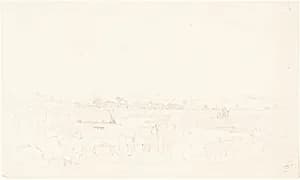
Landscape
first half 19th century
Medium
graphite on wove paper
Dimensions
overall: 13 x 21.8 cm (5 1/8 x 8 9/16 in.)
Classification
Drawing
Department
CG-E
Museum
National Gallery of Art, Washington, D.C.
Credit
Rosenwald Collection
Accession Number
1951.16.197
Rights
Public Domain
Art Historical Context
This delicate landscape drawing, created by an anonymous British artist in the first half of the 19 century, captures the era's fascination with nature's beauty and grandeur. Rendered in graphite on wove paper—a smooth, versatile support that became popular during the Industrial Revolution for its fine texture and ability to hold precise lines—the work measures a modest 13 x 21.8 cm, suggesting it was likely a personal sketch or study rather than a grand exhibition piece. In the Romantic spirit of early 19th-century Britain, such drawings often served as preparatory works for paintings or standalone expressions of the sublime in everyday scenery. Graphite, or pencil, allowed artists like J.M.W. Turner or John Constable—influences from this vibrant period—to achieve subtle shading, atmospheric depth, and intricate details with remarkable control. Though unattributed, this piece reflects the growing democratization of art-making, as affordable materials enabled more artists to document Britain's evolving countryside amid rapid urbanization. Housed in the National Gallery of Art's Rosenwald Collection, renowned for its treasury of drawings and prints, this work offers visitors a window into intimate artistic practice. It reminds us how simple tools could evoke profound emotion, inviting you to trace the artist's hand in every stroke.
About the Artist
British 19th Century · 1800–1899
"British 19th Century" is an attribution designation employed by museums and auction houses to classify paintings, watercolors, drawings, photographs, and decorative objects produced in Britain during the 1800s when the identity of the specific artist has not been established. Like similar geographic and period designations used across the field of art history, it communicates what can be confirme...