
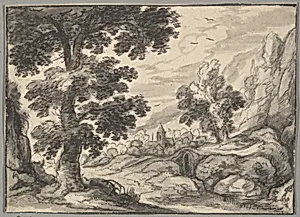
Landscape with a Bridge and a Village Church
Medium
Brush and gray ink, over black chalk; framing line in brush and gray ink
Dimensions
sheet: 5 9/16 x 7 11/16 in. (14.1 x 19.5 cm)
Classification
Drawings
Department
Drawings and Prints
Museum
Metropolitan Museum of Art, New York, NY
Credit
Harry G. Sperling Fund, 2011
Accession Number
2011.298
Rights
Public Domain
Tags
Art Historical Context
This delicate drawing, *Landscape with a Bridge and a Village Church*, captures a tranquil rural scene typical of early seventeenth-century Flemish art. Created around 1600 by an anonymous artist working in the Flemish tradition, the work depicts a modest stone bridge spanning a gentle stream, a village church nestled among trees, and rolling countryside. Such subjects reflect the period’s growing appreciation for the natural world and everyday local landscapes, moving away from purely religious or courtly themes toward more intimate views of the countryside. Executed in brush and gray ink over black chalk with a framing line, the drawing demonstrates the artist’s skillful handling of light and atmosphere. The fluid ink washes create subtle tonal gradations that evoke the soft light of a northern European day, while the underlying chalk provides structure to the composition. At just over five by seven inches, the sheet was likely intended as a finished work for a collector’s album or as a preparatory study, highlighting the intimate scale favored in drawings of this era. Acquired by the Metropolitan Museum in 2011 through the Harry G. Sperling Fund, the piece offers visitors a window into the quiet beauty prized by Flemish draftsmen at the dawn of the Baroque period. Its timeless elements—bridges, churches, and trees—continue to resonate as symbols of connection, community, and the enduring landscape.
About the Artist
Ferdinand Kobell|Anonymous, Flemish, 17th century · 1740–1799
Comment on works: Landscapes with figures; Mountains; times of the day