
Landscape with Trees, Mountains, and Country Lane (from Sketchbook VII)
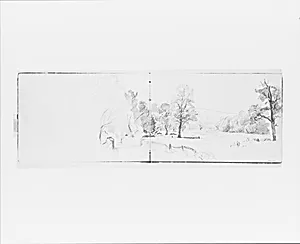
Medium
Graphite on off-white wove paper
Dimensions
5 x 7 1/2 in. (12.7 x 19.1 cm)
Classification
Drawing
Culture
American
Department
The American Wing
Museum
Metropolitan Museum of Art, New York, NY
Credit
Purchase, Gifts in memory of Stephen D. Rubin, 1992
Accession Number
1992.2.1l recto
Rights
Public Domain
Tags
Art Historical Context
William Trost Richards, a leading 19th-century American known for his meticulous landscapes, created *Landscape with Trees, Mountains and Country Lane* in1886 as part of Sketchbook VII. This intimate graphite drawing on off-white wove paper5 x 7½ in.) captures the serene beauty of the American countryside, with its winding country lane flanked by sturdy trees and distant, majestic mountains. Richards, influenced by the precise naturalism of the Pre-Rhaelites and John Ruskin, favored such on-site sketches to study light, texture, and form directly from nature. These small-scale studies were foundational to Richards' oeuvre, bridging his Hudson River School roots with a hyper-detailed realism that celebrated the sublime in everyday scenery. Graphite's subtle tonal range allowed him to render foliage, rocky outcrops, and atmospheric depth with extraordinary fidelity, making this piece a window into his preparatory process for larger oils and watercolors. Now housed in The Metropolitan Museum of Art's American Wing—purchased in 1992 in memory of Stephen D. Rubin—this sketch exemplifies the era's reverence for unadorned wilderness, inviting visitors to appreciate the quiet poetry of the land.
About the Artist
William Trost Richards · 1833–1905
William Trost Richards (1833–1905) was a prominent American landscape and marine painter born in Philadelphia, where he attended Central High School before beginning his artistic training. Between 1850 and 1855, he studied part-time under the German-born Hudson River School artist Paul Weber while working as a designer and illustrator of ornamental metalwork. He exhibited his first works at the Pe...