
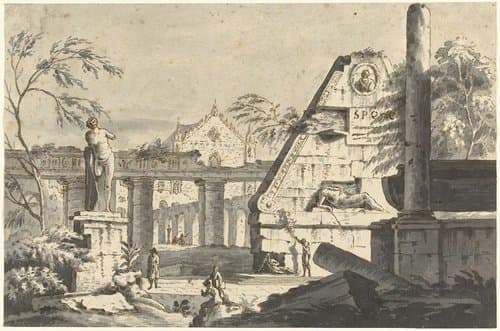
Landschap met antieke ruïnes van gebouwen en beelden
1701 - 1765
Medium
pen
Dimensions
227; 344
Rights
Public Domain
About this artwork
pen in bruin, penseel in grijs
Art Historical Context
Giovanni Paolo Panini (1691–1765), a master of Roman vedute and architectural capricci, crafted this delicate drawing titled *Landschap met antieke ruïnes van gebouwen en beelden*—or "Landscape with Ancient Ruins of Buildings and Statues." Executed in brown ink with gray wash on paper (227 × 344 mm), it captures the evocative decay of classical antiquity, blending precise architectural details with imaginative compositions. Panini's works often evoked the grandeur of Rome's ruins, appealing to 18th-century Grand Tour travelers who romanticized the past. During the Baroque-to-Rococo transition, Panini, as a professor at the French Academy in Rome, elevated topographic views into artistic fantasies. This piece exemplifies his skill in rendering crumbling columns, statues, and overgrown landscapes, symbolizing the passage of time and the enduring allure of ancient Rome. Such drawings were prized by collectors for their scholarly precision and poetic nostalgia. The modest scale and mixed media—pen for sharp lines, brush for atmospheric depth—highlight Panini's technical virtuosity, making ruins feel alive with shadow and texture. A window into Enlightenment-era fascination with history, it invites visitors to ponder humanity's fleeting legacy amid eternal stone.
About the Artist
Giovanni Paolo Pannini
Giovanni Paolo Panini (1691–1765) was born in Piacenza, Italy, where he received his early artistic training under the painters Giuseppe Natali and Andrea Galluzzi, as well as the renowned stage designer Francesco Galli-Bibiena. In 1711, at age 20, he moved to Rome, the eternal city that would define his career, and studied drawing under Benedetto Luti while establishing himself as a fresco decora...