
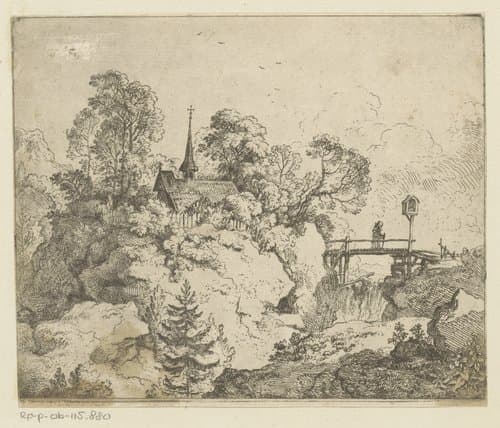
Landschap met kerk en links een kluizenaar op de brug
Medium
etching
Dimensions
185; 155
Rights
Public Domain
About this artwork
height 155 mm x width 185 mm
Art Historical Context
Christian Wilhelm Ernst Dietrich (1712–1774), a prolific German Rococo artist, created *Landschap met kerk links een kluiz op de brug* ("Landscape with Church and Hermit on the to the Left") in 1744. This intimate etching, measuring just 155 mm high by 185 mm wide, Dietrich's mastery of printmaking the Enlightenment era, when detailed landscapes became popular for their evocative escapism amid Europe's growing urbanity. The composition captures a serene Dutch-inspired vista: a sturdy church anchors the scene, while a solitary hermit pauses on a bridge to the left, evoking themes of contemplation and spirituality. Dietrich, influenced by 17th-century masters like Rembrandt and the Dutch Golden Age, skillfully employed etching techniques—using acid to incise fine lines on a metal plate—to achieve rich tonal contrasts and intricate textures, from the bridge's weathered stone to the church's shadowed arches. This method allowed for affordable multiples, democratizing art for collectors. As a window into 18th-century Romanticism's roots, the print reflects cultural fascination with nature's sublime and hermitic withdrawal, blending Rococo elegance with Baroque depth. A gem for print enthusiasts, it invites viewers to ponder quiet moments amid the everyday divine.
About the Artist
Christian Wilhelm Ernst Dietrich · 1712–1774
Christian Wilhelm Ernst Dietrich (1712–1774) was a German painter and etcher of considerable versatility, celebrated in his own time for a chameleonic ability to work convincingly in the manner of the great Dutch and Flemish masters of the preceding century. Born in Weimar, he received early training from his father and later studied under Alexander Thiele in Dresden, the city with which his caree...