
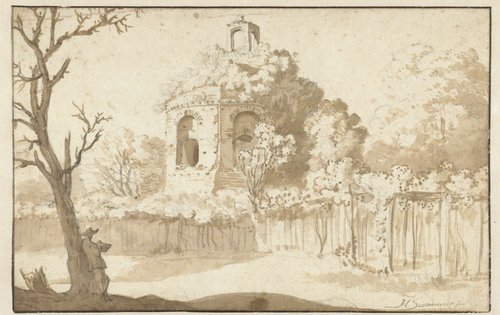
Landschap met ruïne en tekenaar
1629 - 1641
Medium
brush
Dimensions
283; 182
Rights
Public Domain
About this artwork
Mogelijk is afgebeeld Rome
Art Historical Context
Herman van Swanevelt *Landschap met ru en tekenaar* ( with Ruin and Draughtsman), created between 1629 and1641, captures the artist's fascination with the Italian countryside during his time abroad. Rendered in brush on a modest scale—182 mm high by 283 mm wide—this intimate drawing exemplifies the Dutch Golden Age tradition of landscape sketches. Swanevelt, a Utrecht-born painter influenced by his Roman sojourn, blended northern precision with southern grandeur, often idealizing ancient ruins amid lush scenery. The composition likely depicts a Roman vista, as suggested by the evocative ruins and a figure draughtsman at work—perhaps a self-portrait or nod to the artist's own practice. These brush techniques, using fluid washes for depth and light, highlight Swanevelt's skill in evoking atmosphere on paper, bridging studio preparation and plein-air observation. Such works were prized by collectors for their poetic blend of decay and vitality. This piece reflects the 17th-century craze for Italianate landscapes among Dutch artists, symbolizing a cultural pilgrimage to antiquity. Visitors will appreciate its delicate scale, inviting close inspection of Swanevelt's masterful touch.
About the Artist
Herman van Swanevelt · 1603–1655
Herman van Swanevelt (1603–1655) was a leading Dutch Baroque painter, draughtsman, and etcher, celebrated for his luminous Italianate landscapes that bridged the classical ideals of Rome with the emerging naturalism of the Dutch Golden Age. Born in Woerden, near Utrecht, to a family of artisans whose lineage traced back to the renowned Lucas van Leyden, Swanevelt's early life and training remain s...