
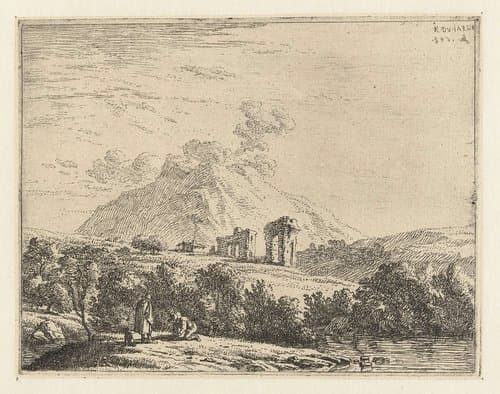
Landschap met ruïne en twee mannen met een hond
1658
Medium
etching
Dimensions
156; 121
Rights
Public Domain
About this artwork
collector's mark: Lugt 240
Art Historical Context
Karel du Jardin’s 1658 etching *Landschap met ruïne en twee mannen met een hond* captures a quiet moment in a pastoral landscape, where two figures and their dog pause beside the weathered remains of a classical ruin. Working in the Dutch Golden Age, du Jardin specialized in Italianate scenes that blended the precise observation of nature with echoes of antiquity. Although modest in scale—only 121 by 156 millimetres—the print demonstrates the artist’s command of the etching needle, using fine, varied lines to suggest both crumbling masonry and the soft textures of foliage and distant hills. Etching was especially suited to such intimate, reproducible works, allowing artists to circulate detailed landscapes among collectors without the expense of painting. Du Jardin’s treatment of light and atmosphere reflects the period’s fascination with the Italian countryside, where ruins served as reminders of time’s passage while also celebrating the enduring beauty of the natural world. The presence of everyday figures and a loyal dog grounds the scene in lived experience, inviting viewers to imagine themselves within this harmonious, sunlit setting.
About the Artist
Karel du Jardin · 1626–1678
Karel Dujardin, born in Amsterdam on September 27, 1626, was the son of the little-known painter Guilliam du Gardin. His early training came under the guidance of Nicolaes Berchem, a master whose influence is evident in Dujardin's animal and landscape depictions, while he was also inspired by the works of Paulus Potter. As a young artist, Dujardin traveled to Italy, where he immersed himself in th...