
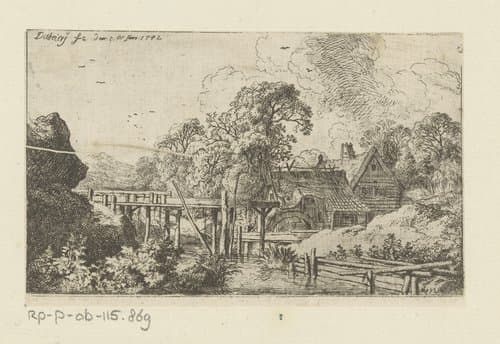
Landschap met watermolen aan de rivier
Medium
etching
Dimensions
85; 136
Rights
Public Domain
About this artwork
Door bij het drukproces aanwezige vouwen in het papier zijn links twee witte strepen ontstaan.
Art Historical Context
**Landschap met waterolen aan de rivier (Landscape with Watermill on the River)** *Christian Wilhelm Ernst Dietrich,1742, etching, 85 × 136 mm* Created in 1742 by German artist Christian Wilhelm Ernst Dietrich1712–1774), this delicate etching captures a serene riverside scene featuring a watermill, evoking the pastoral landscapes popular in 18th-century Europe., a master etcher and painter based in Dresden, drew inspiration from Dutch Golden Age masters like Rembrandt, blending Rococo elegance with meticulous detail. Working during the Enlightenment era, when scientific curiosity fueled interest in nature, his prints like this one offered affordable art to a growing collector class, bridging elite patronage and public appreciation. The intimate scale—barely larger than a postcard—highlights etching's precision: acid bites into a copper plate to create fine lines, inked and pressed onto paper for multiples. A charming imperfection marks this piece: folds in the paper during printing left two white stripes on the left side, a testament to the hands-on craft of 18th-century printmaking. These "flaws" remind us of the artwork's living process, inviting viewers to ponder the river's flow alongside the mill's rhythmic turning wheels—a snapshot of harmonious human-nature interplay.
About the Artist
Christian Wilhelm Ernst Dietrich · 1712–1774
Christian Wilhelm Ernst Dietrich (1712–1774) was a German painter and etcher of considerable versatility, celebrated in his own time for a chameleonic ability to work convincingly in the manner of the great Dutch and Flemish masters of the preceding century. Born in Weimar, he received early training from his father and later studied under Alexander Thiele in Dresden, the city with which his caree...