
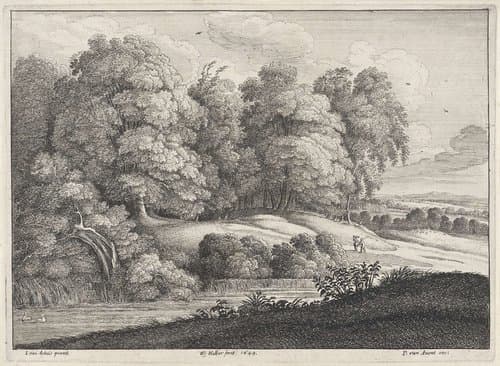
Landschappen naar Jacques d'Arthois
Medium
etching
Dimensions
214; 157
Rights
Public Domain
About this artwork
ets en droge naald
Art Historical Context
**Landschappen naar d'Arthois** is a delicate etching by the masterful Bohemian printmaker Wenceslaus Hol, created in 1649. just 157mm by 214mm, this small yet intricate work reproduces landscapes inspired by the Flemish Baroque painter Jacques d'Arth, known for his poetic depictions of the natural world around Brussels. Hollar, who fled the turmoil of the Thirty Years' and settled in England, was renowned for his prolific output of over 2,500 etchings, capturing everything from city views to natural scenes with astonishing precision. The technique here—etching combined with drypoint ("ets en droge naald" in Dutch)—allowed Hollar to achieve a rich, velvety texture. Etching involves biting lines into a metal plate with acid, while drypoint adds soft, burr-rich strokes directly scratched into the surface, lending a painterly depth that mimics d'Arthois' fluid brushwork. This reproductive print bridged the gap between original paintings and wider audiences, making Flemish landscape artistry accessible in an era when printmaking revolutionized art dissemination. As a snapshot of 17th-century European exchange, Hollar's homage highlights the cross-pollination of styles during the Baroque period, celebrating nature's grandeur amid political upheaval. Visitors will appreciate its fine detail, inviting closer inspection under gallery light.
About the Artist
Wenceslaus Hollar · 1607–1677
Wenceslaus Hollar (1607-1677) was a prolific Bohemian etcher who became one of the most accomplished printmakers of the seventeenth century. Born in Prague, he trained under Matthäus Merian in Frankfurt before entering the service of Thomas Howard, Earl of Arundel, in 1636. Hollar spent most of his career in England, where he produced approximately 2,740 etchings documenting an extraordinary range...