
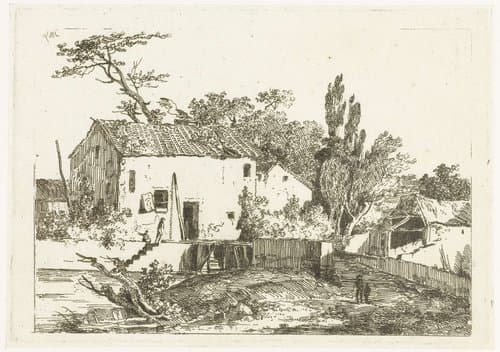
Landweg naar een huis aan het water
1770 - 1779
Medium
etching
Dimensions
121; 174
Rights
Public Domain
About this artwork
collector's mark: Lugt 2228
Art Historical Context
**Landweg naar een huis aan het water** (Country Road to a House the Water), an etching by French artist Louis Gabriel Moreau from the 1770s, captures a serene rural landscape. Created during the late Rococo period, this small print (121 × 174 mm) likely depicts a winding path leading to a modest home nestled by water, evoking picturesque idylls popular in 18th-century art. Moreau, a skilled Parisian engraver active in the second half of the 1700s, specialized in such intimate vignettes, blending delicate natural details with a sense of everyday tranquility. Etching, Moreau's chosen medium, involved drawing lines into a wax-coated metal plate, which acid then etched to produce fine, expressive lines—ideal for replicating the soft textures of foliage, water, and distant architecture. This technique democratized art in the Enlightenment era, allowing affordable reproductions of landscapes that appealed to collectors and the growing middle class. The print's compact size made it perfect for albums or intimate displays, reflecting the era's fascination with pastoral escapes from urban life. Bearing the collector's mark Lugt 2228 (associated with Eugène Dutuit, a 19th-century French bibliophile), this piece highlights its enduring value among connoisseurs. Visitors will appreciate its quiet charm, a window into 18th-century French printmaking's elegance and accessibility.
About the Artist
Louis Gabriel Moreau · 1740–1806
Comment on works: Landscapes; Views of parkland; Ruins; Views of Paris; Ceremonial scenes