
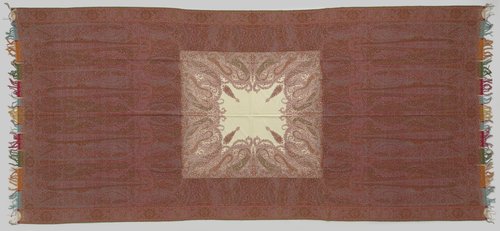
Langwerpige sjaal met rechthoekig veld waarin een vierkante witte spiegel met slanke palmmotieven, de randen bestaan uit S-ranken met lelies en palmetten
ca. 1840 - ca. 1844
Medium
weaving
Dimensions
162; 344
Rights
Public Domain
About this artwork
Wol, zijde, katoen
Art Historical Context
This exquisite anonymous woven shawl, dating to around 1840–1844, exemplifies mid-19th-century textile artistry with its elongated form—measuring approximately 344 cm long by 162 cm wide—perfect for draping elegantly over shoulders or gowns. At its heart lies a striking rectangular central field dominated by a square "white mirror" motif adorned with slender palm patterns, framed by ornate borders of flowing S-scrolls intertwined with lilies and palmettes. These symmetrical designs evoke a sense of luxury, blending classical motifs with exotic flair in European fashion during the Romantic era. Crafted from a luxurious blend of wool, silk, and cotton, the shawl showcases masterful weaving techniques that allowed for intricate, durable patterns without relying on printing. Wool provided warmth and structure, silk added sheen and delicacy, and cotton ensured longevity—materials chosen for both practicality and opulence in an age when such accessories signified status among the elite. Though the maker remains unknown, likely from a skilled workshop, this piece reflects the era's fascination with Eastern-inspired textiles, echoing Kashmiri shawls that captivated Western markets. Its preservation offers a tactile glimpse into 1840s sartorial elegance, inviting visitors to imagine it swirling through ballrooms or promenades.
About the Artist
anonymous
In the vast tapestry of art history, "Anonymous" stands not as a singular individual but as a collective designation for countless unidentified creators whose works have endured across millennia. These artists, spanning prehistoric cave painters to medieval illuminators and folk craftsmen, produced the foundational layers of human visual culture. Prior to the Renaissance, when individual fame emer...