
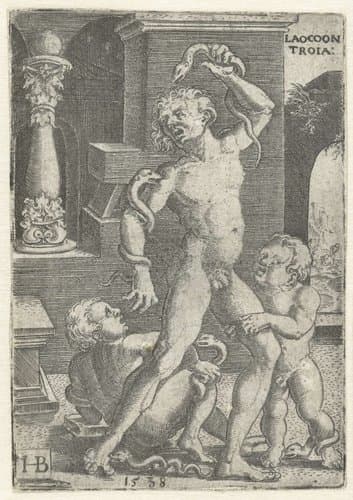
Laocoön en zijn twee zonen gedood door slangen
1538
Medium
engraving
Dimensions
92; 63
Rights
Public Domain
About this artwork
gravure
Art Historical Context
Behold the dramatic engraving *Laocoön en zijn zonen gedood door slangen* (Laocoön and His Two Sons Killed by Sn), created by German artist Hans Brosamer in 1538. Measuring just 92mm high by 63mm wide, this intimate print captures the mythic torment of the Trojan priest Laocoön and his sons, entwined and slain by sea serpents—a scene drawn from Virgil's *Aeneid*. Brosamer, a prolific Northern Renaissance engraver active in the 16th century, masterfully reproduced this iconic motif, making classical antiquity accessible to a wider audience. The subject references the ancient Laocoön statue group, unearthed in Rome in 1506, which ignited Renaissance fascination with Greco-Roman sculpture. Its rediscovery symbolized the era's humanist revival, influencing artists like Michelangelo. Brosamer's engraving, a precise intaglio technique where lines are incised into a metal plate and inked, exemplifies how printmaking democratized art. Small-scale yet richly detailed, it allowed dissemination across Europe, bridging ancient myth with 16th-century viewers. This work highlights engraving's cultural power: affordable, reproducible, and ideal for scholarly exchange. In Brosamer's hands, the writhing figures convey pathos and anatomical vigor, echoing the sculpture's emotional intensity while showcasing Northern precision in linework. A testament to art's enduring storytelling, it invites us to ponder fate's cruel grip.