
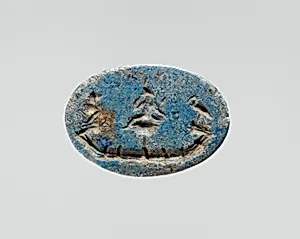
Lapis lazuli intaglio: Harpocrates in a papyrus boat
Unknown Artist
2nd century CE
Medium
Lapis lazuli
Dimensions
Other: 1/2 x 11/16 x 1/8 in. (1.2 x 1.8 x 0.3 cm)
Classification
Gems
Culture & Period
Roman · Imperial
Department
Greek and Roman Art
Museum
Metropolitan Museum of Art, New York, NY
Credit
Gift of Miss Helen Miller Gould, 1910
Accession Number
10.130.1389
Rights
Public Domain
Tags
Art Historical Context
This exquisite lapis lazuli intaglio, in the 2nd century CE Rome's Imperial period, depictsocrates, the youthful Greco-Egyptian god of and secrecy, seated in a delicate papyrus boat. Measuring just 1/2 x 11/16 x 1/8 inches, this tiny gem from the Metropolitan Museum of Art's Greek and Roman collection captures a serene Nile-inspired scene, complete with birds and boats as suggested by its motifs. Lapis lazuli, a rare deep-blue stone prized since ancient times for its celestial hue, was imported from distant Afghanistan, underscoring the vast trade networks of the Roman Empire. Intaglios like this were engraved gems used as seals, signet rings, or amulets, with the image incised into the stone's surface to leave an impression in wax or clay. The technique demanded masterful precision on such a minuscule scale, highlighting the gem-engraver's skill in rendering fine details like the boat's papyrus reeds and accompanying birds—possibly symbolizing the god's watery domain along the Nile. Harpocrates, a Roman adaptation of the Egyptian child-god Horus, embodies mystery cults blending Greek, Egyptian, and Roman traditions. Often shown with a finger to his lips, he here evokes secrecy and divine protection. Donated to the Met in 1910 by Miss Helen Miller Gould, this artifact offers a intimate glimpse into personal piety and artistic luxury in the ancient world.