
Late Picquet
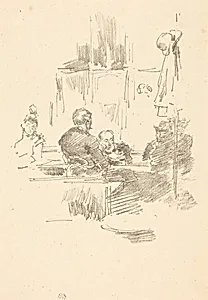
Medium
lithograph in black on laid paper
Dimensions
image: 19.2 × 15.5 cm (7 9/16 × 6 1/8 in.) sheet: 31.5 × 20.2 cm (12 3/8 × 7 15/16 in.)
Classification
Department
CG-W
Museum
National Gallery of Art, Washington, D.C.
Credit
Rosenwald Collection
Accession Number
1943.3.8717
Rights
Public Domain
Art Historical Context
James McNeill Whistler’s *Late Picquet* (4) is a striking lithograph in black on laid paper, capturing artist’s mastery of printmaking during his later career. Measuring just 19.2 × 15.5 cm for the image, this intimate work belongs to the National Gallery of Art’s Rosen Collection. Whistler, the American-born painter and printmaker renowned for his Aesthetic movement ideals—“art for art’s”—turned to lithography in the 1880s and 1890s, producing evocative series that echoed the subtle harmonies of his famous nocturnes. The title *Late Picquet* evokes a soldier on nighttime guard duty (piquet being an old term for picket), rendered with Whistler’s characteristic economy of line and tone. Using lithographic crayon on transfer paper, he achieved velvety blacks and delicate grays, mimicking the atmospheric effects of etching while allowing for subtle gradations on the textured laid paper. This technique highlighted his innovative approach, bridging painting and print to prioritize mood over narrative detail. Part of Whistler’s Chelsea and military-themed lithographs, *Late Picquet* reflects fin-de-siècle fascination with everyday heroism amid urban shadows. Its historical significance lies in advancing lithography as fine art, influencing modern printmakers with its poetic restraint—a perfect gem for contemplating the quiet drama of duty under moonlight.
About the Artist
James McNeill Whistler · 1834–1903
James Abbott McNeill Whistler (1834-1903) was an American-born painter and printmaker who became a leading figure in the Aesthetic Movement and pioneer of Tonalism and Japonisme. He revolutionized art by championing "art for art's sake" and treating paintings as visual equivalents of musical compositions, titling works as "arrangements," "harmonies," and "nocturnes" to emphasize formal qualities o...