
Le Antichità Romane
ca. 1756 - ca. 1757
Medium
etching
Dimensions
46; 400; 482; 488
Rights
Public Domain
About this artwork
collector's mark: Lugt 2228
Art Historical Context
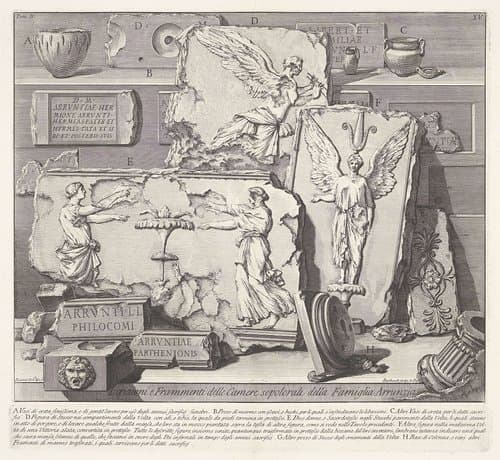
**Le Antichità Romane** is a captivating etching by Giovanni Battista Piranesi, the visionary 18th-century Venetian artist for his dramatic depictions of ancient Roman ruins. Created around 1756–1757, this large-scale print (400 × mm) belongs to Piranesi's ambitious series *Antichità Romane*, meticulously documents the architectural marvels of Rome and its surroundings. Through intricate lines and shadowy depths, Piranesi transports viewers to forgotten temples, aqueducts, and tombs, evoking the sublime power of classical antiquity amid the era's Grand Tour fervor, when European elites flocked to Italy for cultural inspiration. Piranesi's mastery of etching—a printmaking technique using acid to bite designs into metal plates—allowed him to achieve extraordinary detail and texture, far surpassing mere topography. His vedute (topographical views) blend factual accuracy with romantic imagination, emphasizing decay and grandeur to stir awe and melancholy. This plate exemplifies his vedutismo style, influencing neoclassicism and Romanticism alike. Bearing the collector's mark Lugt 2228, the print hints at esteemed provenance, likely from a discerning 19th-century collector, underscoring its enduring allure. A treasure for any virtual museum stroll, it invites us to ponder Rome's eternal legacy.
About the Artist
Giovanni Battista Piranesi · 1720–1778
Giovanni Battista Piranesi (1720–1778) was an Italian printmaker, architect, and antiquarian whose visionary etchings of Rome and imaginary prisons revolutionized architectural representation and profoundly influenced both Neoclassicism and Romanticism. Piranesi stands as one of the most important printmakers of the eighteenth century, fundamentally shaping European perceptions of ancient Rome an...