
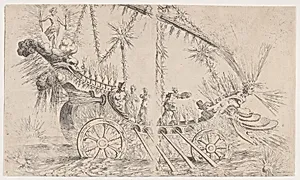
Le Char de l'Amour appelé aussi Le Vausseau d'Artifice (The Ship of Love also called the Ship of Fireworks)
ca. 1615
Medium
Etching; second state of two (Lieure)
Dimensions
Sheet: 6 3/4 x 11 9/16 in. (17.2 x 29.4 cm)
Classification
Prints|Ornament & Architecture
Department
Drawings and Prints
Museum
Metropolitan Museum of Art, New York, NY
Credit
Harris Brisbane Dick Fund, by exchange, 1940
Accession Number
40.52.13
Rights
Public Domain
Art Historical Context
**Le Char de l'AmourThe Ship of Love, also called the Ship ofworks)**, created around 1615 by French etcher Jacques Callot in collaboration with Italian painter Matteoelli, captures the extravagant spirit of Renaissance festivities. This etching, in its second state of two as cataloged by Lieure, an elaborate ornamental float shaped like a ship, likely designed for opulent court celebrations in Florence under Medici patronage. Callot, renowned for his intricate etchings of spectacles and carnivals, masterfully renders the vessel brimming with cupids, fireworks, and architectural flourishes, blending love's romance with pyrotechnic drama. Etching allowed Callot to achieve unprecedented detail in such small-scale works—here, on a sheet measuring just 6 3/4 x 11 9/16 inches—producing fine lines that evoke the bustling energy of Baroque-era pageantry. Classified under Prints: Ornament & Architecture, it highlights the era's fusion of design and performance art, where temporary structures like this "ship" served as centerpieces for public revelry. Today, housed in the Metropolitan Museum of Art's Drawings and Prints department (Harris Brisbane Dick Fund, 1940), it offers a vivid window into 17th-century Europe's cultural splendor, reminding us how art illuminated fleeting joys.
About the Artist
Jacques Callot|Matteo Rosselli · 1592–1635
Jacques Callot (1592–1635) was a French printmaker and draftsman from the Duchy of Lorraine, widely regarded as one of the first great artists to practice the graphic arts exclusively. His more than 1,400 etchings chronicled the breadth of 17th-century life, from Medici court festivities to the brutal realities of warfare. Callot revolutionized etching through technical innovations including the é...