
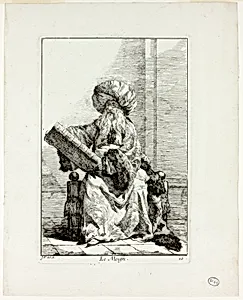
Le Moufti, plate ten from Caravanne du Sultan à la Mecque
Medium
Etching on ivory laid paper
Dimensions
Image: 19.4 × 13.1 cm (7 11/16 × 5 3/16 in.); Plate: 20.4 × 13.5 cm (8 1/16 × 5 3/8 in.); Sheet: 26.3 × 21 cm (10 3/8 × 8 5/16 in.)
Classification
etching
Department
Prints and Drawings
Museum
Art Institute of Chicago
Accession Number
207702
Rights
Public Domain
Art Historical Context
**Le Moufti from *Caravanne du Sultan la Mecque*** in 1748 by French artist Joseph-Marie Vien, *Le Moufti* is the tenth plate in his evocative series *Caravanne Sultan à la Mecque capturing the grandeur of an imagined Ottoman pilgrimage to Mecca. Vien, a pivotal figure bridging Rococo elegance and emerging Neoclassicism, on 18th-century European fascination with the "Orient." This etching depicts the Mufti—a high Islamic legal authority—amid the caravan's exotic procession, blending observed details from travel accounts with artistic imagination to evoke mystery and splendor. Rendered as a delicate etching on ivory laid paper (image: 19.4 × 13.1 cm), Vien masterfully employed intaglio techniques: lines incised into a metal plate with acid, then inked and printed for rich tonal contrast. The modest plate size (20.4 × 13.5 cm) made it ideal for collectors' albums, highlighting etching's precision for intricate textures like flowing robes and distant dunes. Housed in the Art Institute of Chicago's Prints and Drawings Department, this work reflects Enlightenment-era Orientalism, offering visitors a window into how Western artists romanticized Islamic culture. Its survival on fine laid paper underscores the era's printmaking boom, making art accessible beyond paintings. A captivating blend of curiosity and craft! (198 words)
About the Artist
Joseph Marie Vien, I · 1716–1809
Joseph-Marie Vien (1716–1809) was born in Montpellier and trained in Paris under Charles-Joseph Natoire. A brilliant student, he won the Prix de Rome in 1743 and spent the years 1744 to 1750 at the French Academy in Rome, where his encounter with the antiquarian scholarship of the Comte de Caylus and the early stirrings of neoclassical taste around the discoveries at Herculaneum and Pompeii proved...