
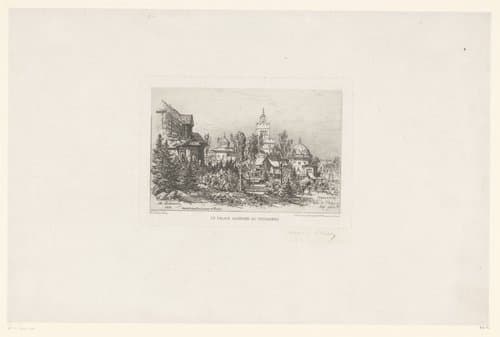
Le palais algérien au Trocadero
Medium
etching
Dimensions
208; 147
Rights
Public Domain
About this artwork
watermark
Art Historical Context
### Le Palais Algérien au Trocadéro Created in 1879 by French etcher Maxime François Antoine Lal (1827–1886), *Le Palais Algérien au Tadéro* captures a striking architectural moment from Paris's recent past. Lalanne, a master of 19th-century printmaking, specialized in detailed etchings of urban landscapes and exotic structures, blending technical precision with atmospheric depth. This intimate work, measuring just 147 × 208 mm, showcases his skill in rendering intricate Moorish-inspired facades through the delicate lines of etching—a process where acid bites into a metal plate to create rich tonal variations. The image depicts the Algerian Pavilion at the Palais du Trocadéro, built for the 1878 Exposition Universelle in Paris. This world's fair celebrated French colonial achievements, with the pavilion evoking Algiers's opulent palaces through arches, tiles, and arabesques. Lalanne's etching preserves this temporary marvel, which symbolized France's North African empire amid the era's Orientalist fascination. A subtle watermark on the paper hints at the artisanal quality of period printmaking, often used to authenticate fine editions. As a window into imperial spectacle, the print invites us to reflect on how 19th-century fairs blended culture and conquest, offering visitors a taste of distant lands right in Paris. (198 words)