
Le petit Russe
1860s
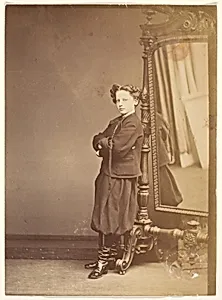
Medium
Albumen silver print from glass negative
Dimensions
9.5 x 11.7 cm. (3 3/4 x 4 5/8 in.)
Classification
Photographs
Department
Photographs
Museum
Metropolitan Museum of Art, New York, NY
Credit
David Hunter McAlpin Fund, 1975
Accession Number
1975.548.233
Rights
Public Domain
Tags
Art Historical Context
**Le Petit Russe** (The Little Russian), a delicate albumen silver print from glass negative by Pierre-Louiserson, captures the charm of 1860s photography at its finest. Created around this vibrant era of French portraiture, the image measures a compact 9.5 x 11.7 cm—ideal for the popular carte de visite format that made photography accessible to the masses. Pierson, a master of the medium associated with elite studios like Disderi, produced sharply detailed, richly toned prints that brought intimate moments to life. This poignant portrait features a child, evoking tenderness and curiosity through its use of a mirror, a clever compositional device common in mid-19th-century photography. Mirrors not only added depth and reflection but also symbolized introspection or doubled the subject's presence, enhancing the emotional resonance. As an albumen print, the work showcases the era's technical pinnacle: egg-white-coated paper yielding luminous highlights and subtle gradations from glass negatives. Housed in the Metropolitan Museum of Art's Photographs Department (David Hunter McAlpin Fund, 1975), *Le Petit Russe* reflects photography's rise as an art form, bridging portrait traditions with innovative techniques. Its tags—mirrors, children, portraits—highlight a cultural fascination with youth and exoticism, inviting viewers to ponder the little one's story amid Second Empire elegance.
About the Artist
Pierre-Louis Pierson · 1822–1913
Pierre-Louis Pierson (1822–1913) was a pioneering French portrait photographer whose career spanned the formative years of the medium. Born on December 13, 1822, in Hinckange in the Moselle department, Pierson developed an early fascination with photography during the 1840s, as the daguerreotype was still in its infancy. His early life and formal training remain sparsely documented, but by 1844, h...