
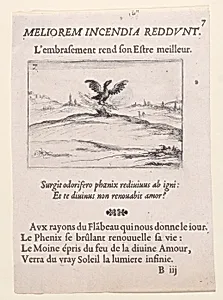
Le Phénix se Brulant (The Phoenix is Burning), from Lux Claustri ou La Lumière du Cloitre (The Light of the Cloisters), plate 7
Medium
Etching; second state of two (Lieure)
Dimensions
Sheet: 5 15/16 x 4 1/4 in. (15.1 x 10.8 cm) Plate: 2 5/16 x 3 5/16 in. (5.8 x 8.4 cm)
Classification
Prints
Department
Drawings and Prints
Museum
Metropolitan Museum of Art, New York, NY
Credit
Bequest of Edwin De T. Bechtel, 1957
Accession Number
57.650.348(7)
Rights
Public Domain
About this artwork
This impression of Jacques Callot's "Le Phénix se Brulant" represents a variant printing of the emblematic image discussed earlier, though with slightly different sheet dimensions indicating a different impression or trimming. Like its companion, this etching formed part of "Lux Claustri ou La Lumière du Cloitre," the series of spiritual emblems created between 1621 and 1635. The phoenix motif—showing the mythical bird consumed in redemptive fire—carried profound Christian symbolism of resurrect...
Art Historical Context
**Le Phénix se Brulant (The Phoenix is)**, plate 7 from Jacques Callot's *Luxustri ou La Lumière Cloitre* (The of the Cloisters), a exquisite etching created between 1621 and 1635. This tiny print—its plate measuring just 2⅜ x 3⅜ inches—captures the mythical phoenix engulfed in flames, a powerful Christian emblem of resurrection and spiritual rebirth. Part of a series of spiritual emblems blending image and moral lesson, it draws from the 17th-century emblem book tradition, making profound theological ideas vivid and accessible. Renowned Baroque etcher Jacques Callot, often published by François Langlois, showcases his revolutionary technique here. Working in the second state of two (as catalogued by Lieure), Callot achieves astonishing detail, tonal subtlety, and linear precision on such a minuscule scale, influencing countless printmakers. Variations in impressions, like this one's sheet trimmed to 6 x 4¼ inches, reflect the era's printing practices, where sheets were handled differently over time. Acquired through Edwin De T. Bechtel's 1957 bequest to The Metropolitan Museum of Art, this work highlights Callot's mastery in merging artistry with devotion, inviting visitors to ponder transformation amid fiery renewal.